


It is 6 p.m., and six vehicles arrive at a fast-charging station.
Suppose the site has 600 kW of charging power available. Six vehicles, 100 kW each. That seems reasonable.
But once they plug in, the picture changes.
One vehicle can currently accept only 60 kW. Another is nearly full, and its demand has dropped to 40 kW. A third has just arrived with a low battery and could still accept considerably more power.
If each charging point has a fixed 100 kW allocation, the first two vehicles leave a combined 100 kW unused. That capacity may be unavailable to the other vehicles, even when they need it.
The result is an awkward situation: some charging capacity sits idle while drivers who could benefit from more power continue to wait.
This is a simplified example, but it highlights a question that is easy to overlook when selecting charging equipment:
How much power a station has and how much of that power it can actually use are two different things.
Six Vehicles Do Not Need Six Equal Shares
Charging demand is never uniform.
Battery capacity, state of charge, temperature and the vehicle’s own charging capability all affect how much power it can accept at any moment. Even for the same vehicle, demand changes between plugging in and approaching a full battery.
Giving every vehicle an identical power allocation therefore does not necessarily make the station more efficient.
In our example, if the system can recognize changing demand and its hardware supports power reassignment, capacity left unused by the first two vehicles could become available to others that still need it.
Those vehicles may finish their required charging sooner, potentially freeing their bays for the next drivers.
This does not mean every vehicle will charge faster. A vehicle that can accept only 60 kW will not benefit from a larger allocation. And if all six vehicles request high power, their combined demand may still exceed the site’s 600 kW limit.
Dynamic allocation helps within those limits. Its purpose is to reduce situations in which capacity remains unused in one place while demand goes unmet elsewhere.
Software Can Make the Decision. Hardware Must Deliver It.
This helps explain the industry’s growing emphasis on power management.
ChargePoint describes its dynamic load management solution as adjusting available charging power in response to changing site loads and charging demand. Where chargers share an electrical supply with a building, that process also accounts for other electricity consumption to keep the total load within site limits. Source: ChargePoint Dynamic Load Management.
However, site-level load management and the allocation of power modules inside a charging system address two connected questions.
The first is: how much power can the charging system use right now?
The second is: how can the hardware distribute that power among the charging terminals?
Consider a site with several independent all-in-one DC chargers. Increasing the software power limit on one charger does not give it access to the power modules inside another. It also cannot exceed its own output capability.
The ability to send a control command therefore does not mean that every charger can share power modules with every other charger. The actual allocation range depends on the modules, electrical routing, terminals and control architecture.
For operators, this adds an important question to the equipment selection process:
When one vehicle no longer needs its allocated capacity, where can that capacity go?
What Does a 40 kW Allocation Increment Actually Do?
Once a system can reassign power among terminals, the next question is how much capacity it can move at a time.
This is where allocation granularity matters.
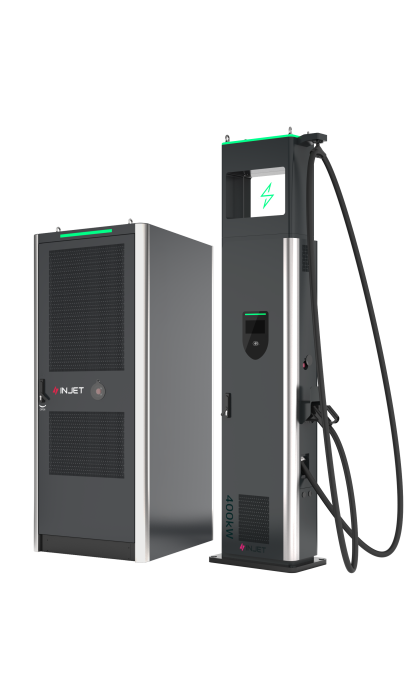
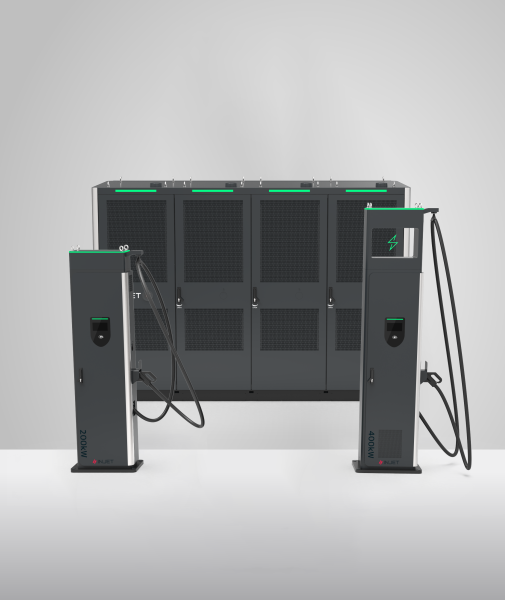
Injet HanYuan uses 40 kW power modules as its allocation units. Within the system’s supported routing configuration, module assignments can change in 40 kW increments as vehicle demand changes.
When demand at one terminal falls, modules that can be released become available for reassignment to terminals with higher demand. A vehicle does not have to remain tied to its initial fixed share throughout the charging session.
The 40 kW figure describes module allocation, rather than requiring actual charging output to remain at exact multiples of 40 kW. Delivered power still depends on vehicle requests, voltage, current and equipment operating limits.
Nor does modular allocation eliminate all unused capacity. Module combinations, terminal limits and changing vehicle demand still affect the result. It gives the system more flexibility to make productive use of the capacity already installed.
Using Available Power Still Requires Managing Peak Costs
More flexible allocation does not mean a station should operate at maximum power at all times.
For sites on tariffs that include demand charges, measured peak demand can influence electricity costs. Sites sharing a connection with other facilities must also leave sufficient capacity for those loads.
Equipment-level allocation therefore needs to work within the site’s overall power limit, distributing available modules according to vehicle demand.
ChargePoint’s power management materials also identify capacity management and demand-charge control as applications. Whether these measures reduce costs depends on the local tariff and the site’s actual load profile. Source: ChargePoint Power Management FAQ.
At a public fast-charging station, drivers’ time must also be part of the calculation. Lowering power may reduce certain costs, but it can lengthen charging sessions, increase bay occupancy and create queues.
A suitable operating strategy balances service efficiency, available capacity and electricity costs for that particular location.
Look Beyond the Maximum Power Rating
A maximum power figure alone cannot tell an operator how effectively a charging station will perform.
That also depends on how quickly changing vehicle demand is recognized, whether available modules can be reassigned, and whether those changes remain within site and equipment limits.
When comparing two systems with the same rated power, put the six vehicles from our 6 p.m. example into the proposal.
One can accept only 60 kW. Another is almost full. A third could use more power.
Where can the unused modules go?
- Previous:
- Next: The Chargers Are Here. When Will the Power Arrive?