


The parking bays have been marked. The cable trenches have been filled. Newly delivered chargers, still wrapped in protective film, stand neatly beside the spaces.
The construction team has left, and platform integration is already on the schedule. Most items on the project tracker are green. Only one field remains blank:
“Energization date: To be confirmed.”
The problem is not delayed equipment or unfinished software.
Everyone is waiting for the same thing: confirmation that the grid can provide the capacity the site requires.
On a project plan, this may look like just another missing date. For a charge point operator, however, rent, financing and project management costs do not stop while the site waits. For drivers, it simply means one fewer fast-charging station available on the map.
The chargers have arrived. The power is still on its way.
When Charging Power Moves Faster Than the Grid
The power capability of DC charging equipment has risen rapidly over the past few years.
The industry has moved from tens of kilowatts to hundreds of kilowatts, while megawatt-scale charging is beginning to enter commercial applications. Vehicles can receive more energy in less time, but there is a growing mismatch behind those improvements.
A charger’s specifications can advance with each new product generation. A site’s grid connection cannot be upgraded in the same way.
A high-power charging site may require a new transformer, additional distribution equipment and substantial grid works. Capacity assessments, permitting, engineering, construction and final energization can all influence when the station actually opens.
In some markets, the delivery time of the charger is no longer the deciding factor. The grid connection is.
This is not an isolated project problem.
In a recent update on the Spanish market, Alpitronic noted that more than 2,000 installed DC charging ports in Spain are powered by its technology. It also identified the complexity of grid connections as one reason charging infrastructure can take time to deploy.
The significant point is not simply the number of charging ports. It is the contrast behind it:
The faster charging equipment is deployed, the more visible grid access becomes as a constraint on further expansion.
Operators may be able to purchase higher-power chargers and secure attractive locations. But if a site can obtain only limited electrical capacity, the maximum power printed on the charger does not represent the power the station can consistently deliver.
What Can Operators Do When Power Is Limited?
The most direct option is to wait for and invest in a grid upgrade.
This can increase the site’s long-term power capacity, but it may also involve a longer development period and additional spending on transformers, distribution equipment, construction and capacity-related charges.
Another option is to use the available capacity more intelligently.
When several vehicles connect at the same time, dynamic power allocation can distribute the site’s available power according to vehicle demand, charging status and the total capacity limit. It does not increase the grid connection, but it can improve how effectively that capacity is used.
A third option is receiving increasing attention: adding on-site energy storage.
XCharge’s GridLink provides one visible example. Designed for locations with limited grid capacity, it integrates a 215kWh battery with the charging system, allowing the grid and battery to support higher charging output together.
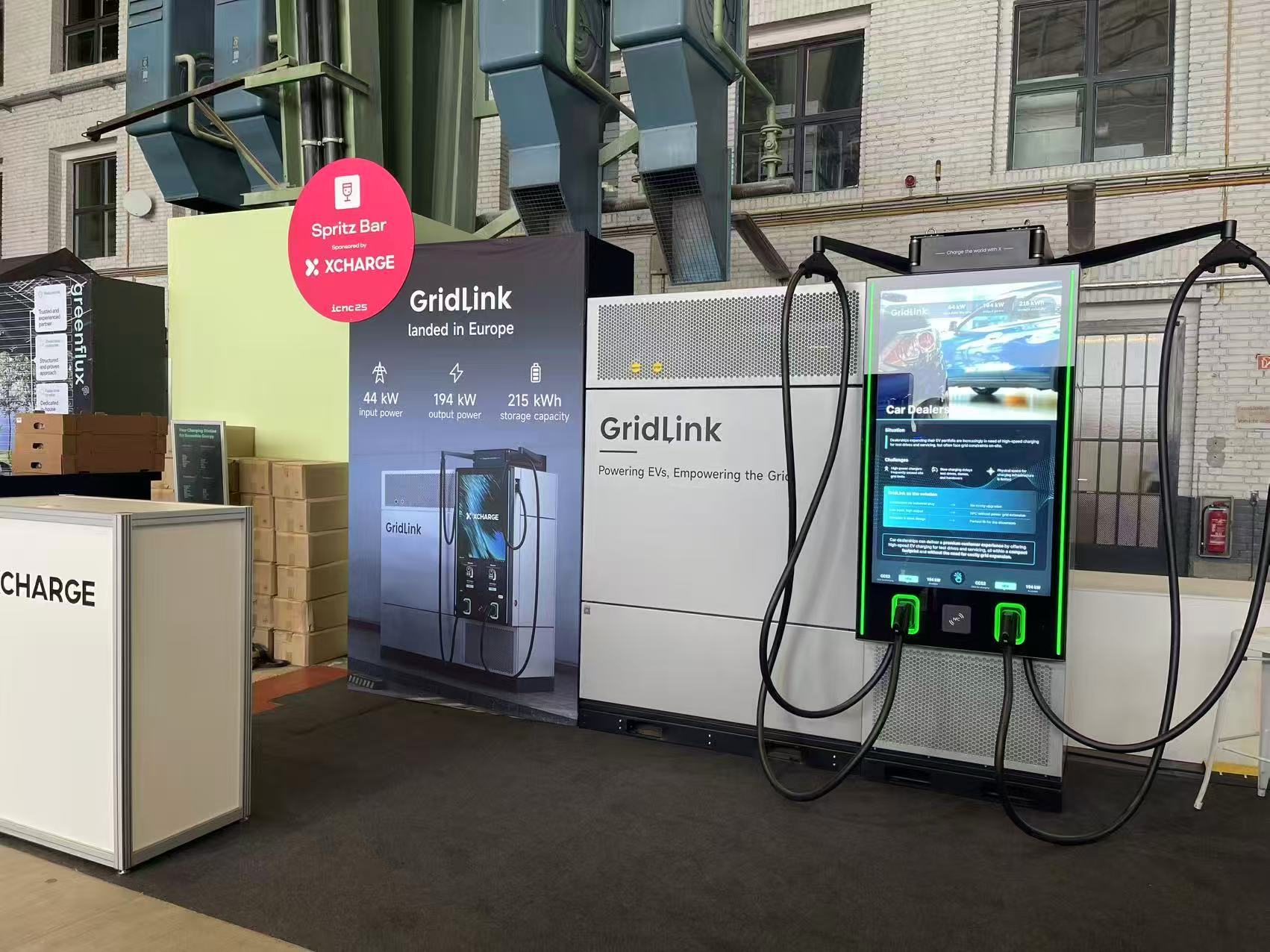
The wider significance is not one particular product. It is the industry thinking behind it.
When the grid cannot provide sufficient instantaneous power, energy can be stored during lower-demand periods and released when several vehicles arrive or higher charging power is required.
The charger is therefore no longer simply a channel between the grid and the vehicle. It is becoming part of a broader site energy system involving storage, renewable generation and intelligent energy management.
Storage Can Shift Power, but It Cannot Create Energy
Energy storage is not a universal replacement for grid expansion.
It can change when electricity is used, but it cannot create additional energy.
If a charging station experiences several short demand peaks followed by relatively quiet periods, a battery can recharge when demand is low and provide additional power during the next peak. Storage may also help operators manage demand charges or make better use of on-site solar generation.
The calculation changes when vehicles arrive continuously throughout the day. If the battery discharges faster than the grid or on-site generation can replenish it, the site will eventually return to the limit of its available power supply.
That is why a storage system should not be selected by battery capacity alone.
Operators need to understand the available grid capacity, the duration and frequency of charging peaks, daily energy demand, simultaneous charging patterns, electricity tariffs and the time and cost required for a future grid upgrade.
In practice, the answer may be a combination of grid expansion, dynamic power allocation, storage and renewable generation.
The real competition is therefore moving beyond charger power. It is becoming a question of site energy architecture.
From a Charging Site to a Managed Energy System
Storage does not necessarily have to be built into every charger. It can also operate as a site-level energy unit, coordinating the grid, photovoltaic generation, stored energy, backup generation and connected loads.
This is where solutions such as the Injet HanCang 261kWh can play a role.
HanCang is a compact, pre-assembled distributed power solution designed for weak-grid, off-grid and power-constrained applications. It integrates a 261kWh LFP battery system, BMS, power conversion, liquid cooling, fire protection and dispatch control, together with interfaces for photovoltaic generation and reserved space for a charging module.

Depending on the project configuration, it can support peak shaving, dynamic capacity expansion and off-grid power supply. Rather than treating storage as a way to make a charger’s headline power appear larger, HanCang provides an additional layer of energy buffering and coordination at the site level.
It is not intended to replace every grid upgrade. Instead, it gives project developers another option when sufficient grid capacity is delayed, restricted or temporarily unavailable.
The next fast-charging project may therefore need to answer a more fundamental question before choosing the charger’s maximum power:
When the busiest 30 minutes of the day arrive, where will the electricity come from?
Learn more about the Injet HanCang 261kWh energy storage system.