


When Alpitronic unveiled its HYC400 Series 2 fast charger in March 2026, the industry didn’t just notice a larger screen. It noticed a shift in priorities: this flagship product had been redesigned with wheelchair users at the center of the process. That wasn’t a marketing decision. It was a regulatory one.
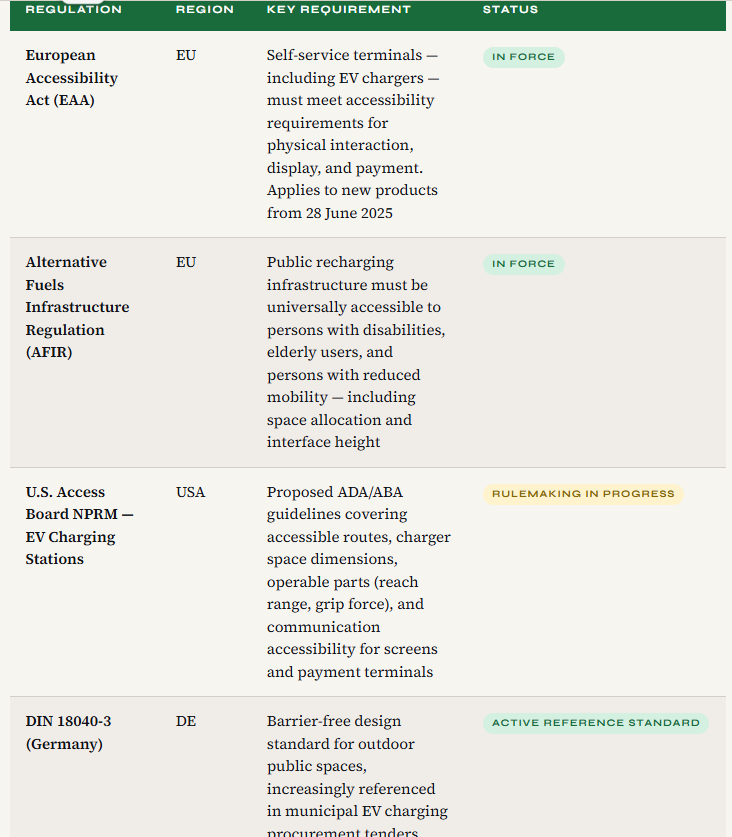
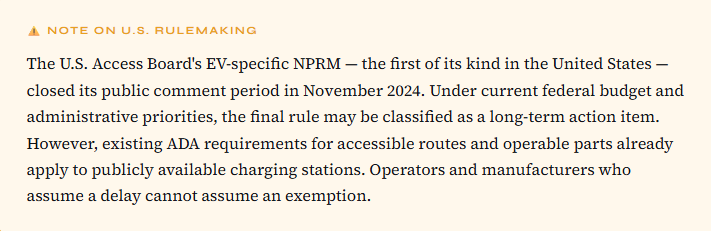
Accessibility requirements for EV charging infrastructure are tightening on both sides of the Atlantic. The European Accessibility Act (EAA) entered into force in June 2025. In the United States, the U.S. Access Board published its first-ever dedicated Notice of Proposed Rulemaking (NPRM) for EV charging stations in September 2024, with formal rulemaking now underway. And the EU’s Alternative Fuels Infrastructure Regulation (AFIR) already mandates that public charging infrastructure be universally accessible — a term now being tested against real hardware.
For EV charging manufacturers, CPOs, and fleet operators planning multi-year infrastructure rollouts, the direction is clear: accessible design is no longer a differentiator. It is a baseline requirement.
The Regulatory Landscape: What’s in Force, What’s Coming
Understanding the timeline is critical for procurement planning. Here is a concise overview of the key frameworks shaping the accessible EV charging space in 2025–2026:
What “Accessible” Actually Means for a Charging Station
Physical Interface Requirements
Operable parts — screens, payment terminals, cable connectors, holsters — must fall within defined reach ranges for seated users. Under ADA guidelines, a side-reach maximum of 48 inches (122 cm) and a forward-reach maximum of 48 inches apply. For a user in a power wheelchair with a large turning radius, the placement of the charge point relative to the parking space geometry is equally critical.
Cable and Connector Usability
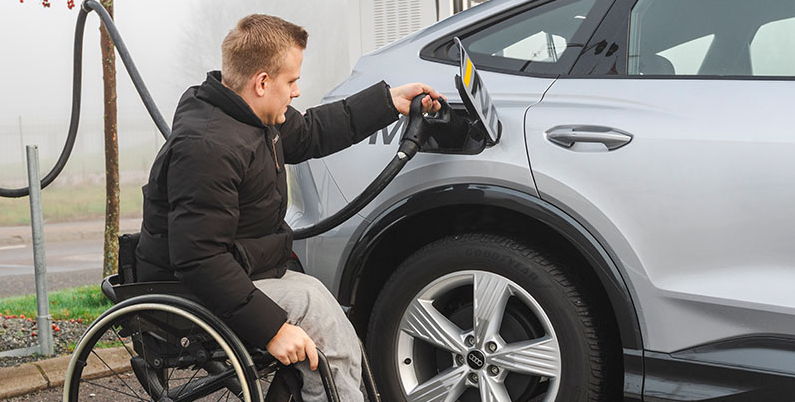
Charging cables remain one of the most underappreciated accessibility challenges. A heavy, stiff cable — particularly a combined CCS2 or CHAdeMO connector — can be extremely difficult to handle for users with reduced grip strength, limited upper-body mobility, or prosthetic limbs. Cable weight, hang angle, connector grip diameter, and locking mechanism force are all measurable, specifiable parameters that accessible design must address.
Screen and Payment Terminal Accessibility
The EAA specifically covers self-service terminals as a product category. Requirements include screen readability at low angles (relevant for seated users), audio output options, tactile feedback, and time-out durations that allow users who process information more slowly to complete transactions without interruption. Contactless payment at a reachable height is no longer optional in compliant European deployments.
Accessible Parking and Routing
Both AFIR and the proposed U.S. rules address the space around a charger, not just the charger itself. An accessible EV charging space requires minimum clear floor space adjacent to the vehicle parking area, surfacing requirements, and an unobstructed route to the charger interface. Site planning and charger placement are therefore as important as the hardware specification.
Why This Matters More for Fleet and Commercial Charging
For depot-based fleet charging and public transit applications, accessible design introduces an additional layer of complexity: space constraints. A bus depot or logistics hub is not designed like a retail forecourt. Charging equipment must integrate into tight row layouts, often with multiple vehicles charging simultaneously, limited apron width, and overhead obstructions.
This is the environment where traditional charger designs — a single pedestal with a cable coiled at mid-height — perform worst for accessibility. The interface may be obscured by the vehicle itself. The cable may be routed at an angle that makes it difficult to handle from a seated position. And in a busy depot environment, there may be no designated accessible bay at all.
Yet the operators of bus fleets, logistics companies, and public transit authorities are subject to the same non-discrimination obligations as any other public-facing transport service provider. As electrification of these fleets accelerates — EAFO data shows BEV buses in the EU exceeded 8,500 registrations in 2025, with a 22.4% new-vehicle market share — the question of whether the charging infrastructure serving those vehicles is accessible becomes unavoidable.
Injet New Energy’s Approach to Accessible Charging
At Injet New Energy, we believe that infrastructure designed for the most demanding users performs better for all users — not merely as a compliance requirement, but as a genuine design philosophy.
Here is how INJET’s current and planned product developments address accessibility in real deployment conditions:
• Optimized Charging Cable Ergonomics
Injet EV chargers are developed with cable weight, hang angle, and connector grip in mind from the outset. We are actively refining our charging gun design to address the most common usability pain points experienced by users.
• Overhead / Suspended Terminal Architecture for Fleet Environments
For fleet charging applications — bus depots, logistics hubs, and transit authority facilities — Injet New Energy is developing a suspended terminal configuration for our power stack product line. This reduces dependency on pedestal placement relative to the parking bay, and is particularly well-suited to articulated bus bays and high-density commercial vehicle rows where side-mounted pedestals are inaccessible or obstructed.
Build Accessible Charging from the Start
Talk to the Injet New Energy team about accessibility requirements for your next fleet depot, CPO rollout, or public charging project. We’ll walk you through our product specifications, compliance documentation, and custom configuration options.