


As electric vehicles continue to gain global momentum, charging infrastructure has become a critical backbone supporting the transition to electric mobility.
Unlike indoor equipment, however, most EV chargers operate outdoors—often exposed to harsh and unpredictable weather conditions.
From winter snowstorms in Northern Europe to summer heat waves across the UK, from heavy rainfall to complex electrical environments, reliability has become one of the most important performance indicators for EV charging infrastructure.
For charging network operators, it is no longer enough for chargers to simply function—they must operate consistently and reliably under all conditions.

Extreme Weather Is Becoming a Growing Challenge for Charging Infrastructure
In recent years, climate fluctuations have increased the frequency of extreme weather events worldwide.
Europe experienced severe cold waves and heavy snowfall in several regions in 2025, while parts of the UK and Southern Europe also faced unusually high summer temperatures.
Such conditions can pose significant challenges for outdoor charging equipment.
Extremely low temperatures may affect electronic components, displays, and connectors, while high temperatures can impact thermal management and internal system stability.
Heavy rain, water splashes, and electromagnetic interference in urban environments can also affect equipment performance.
As a result, the ability to operate reliably under harsh environmental conditions is becoming a key benchmark for EV charger quality.
Reliability Starts with Rigorous Testing
True reliability is not proven only in the field—it begins with rigorous laboratory testing.
Injet New Energy operates a comprehensive charging equipment testing system supported by the Injet Electric Testing Center, which has received accreditation from the China National Accreditation Service for Conformity Assessment (CNAS).
Through advanced environmental simulation systems, Injet can conduct extensive reliability testing before products are deployed in the market, ensuring chargers can adapt to different climate conditions worldwide.

Temperature Testing: Simulating Environments from -40°C to +90°C
In Injet’s laboratories, chargers undergo strict high- and low-temperature testing.
Testing chambers can rapidly adjust temperatures from -40°C to +90°C, simulating both extreme cold and extreme heat while monitoring charger performance in real time.
These tests confirm that:
-
Injet DC&AC chargers remain stable at -35°C
This capability is particularly important for regions with severe winters, ensuring reliable charging even during snowstorms and freezing conditions.
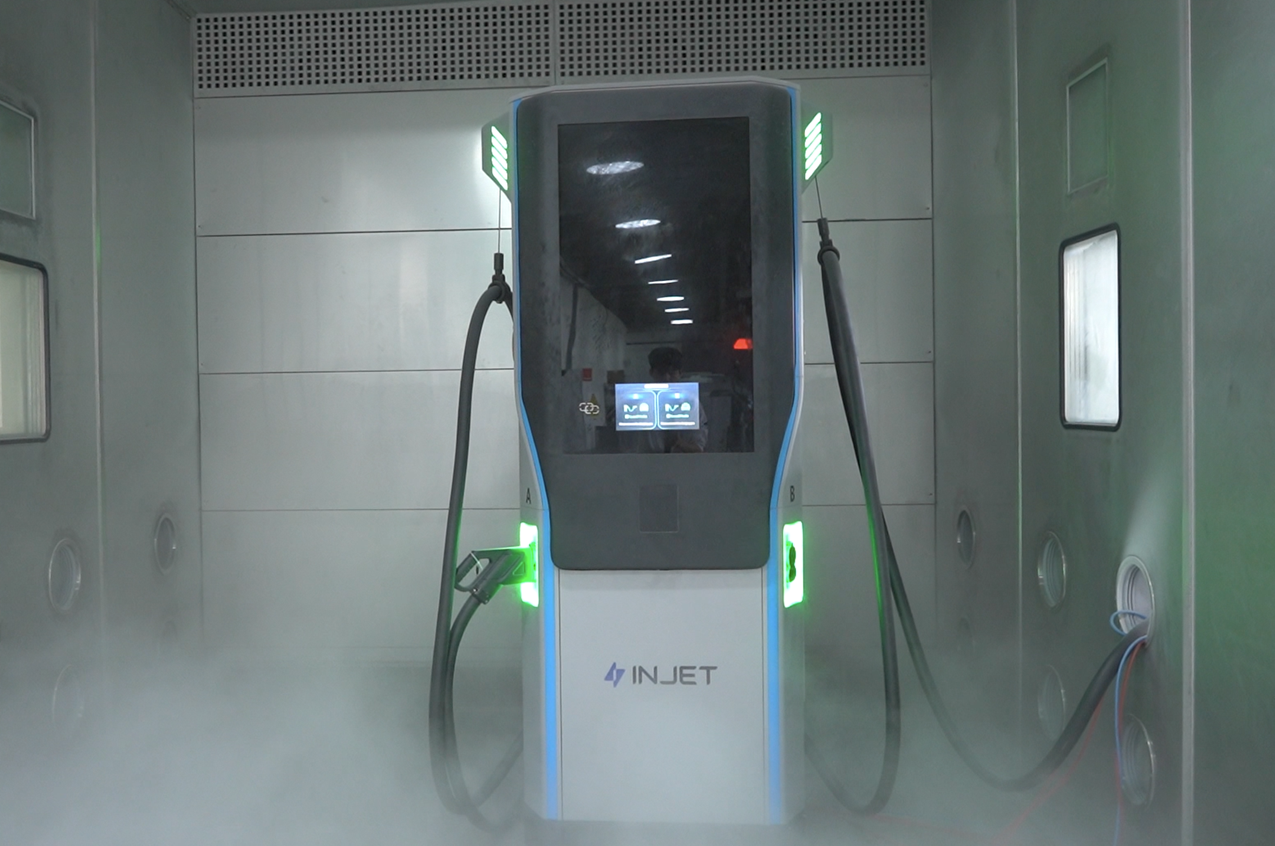
Protection Against Rain and Water Exposure
Outdoor chargers must also withstand rain, water splashes, and challenging weather conditions.
Injet chargers feature high-standard protective designs and undergo strict water spray testing to verify durability in wet environments.
With IP54+ protection ratings, the equipment can maintain stable operation during heavy rain and water exposure, ensuring reliable service for EV drivers even in adverse weather conditions.

EMC Testing: Ensuring Stability in Complex Electrical Environments
Charging stations are often installed in locations with complex electrical environments, such as commercial areas, industrial zones, and transportation hubs.
Injet New Energy’s EMC (Electromagnetic Compatibility) laboratory conducts rigorous testing to evaluate both electromagnetic emissions and resistance to interference.
This ensures that chargers can:
-
1)Operate reliably within complex power grids
-
2)Avoid interfering with surrounding electronic equipment
-
3)Resist external electromagnetic disturbances
Such testing is critical for ensuring stable performance across diverse deployment scenarios.

Proven Performance in Real-World Conditions
Beyond laboratory testing, real-world operation is the ultimate proof of charger reliability.
Today, INJET Swift AC chargers are already operating in Hungary, where they continue to perform reliably even during heavy snowfall and freezing winter conditions.
In addition, INJET Ultra has demonstrated stable operation in snowy weather conditions in Denmark, providing dependable charging services to EV drivers.
These real-world deployments demonstrate that chargers built with rigorous testing standards can maintain reliable performance across diverse and challenging climates.


Reliability: A Core Capability for the Next Generation of Charging Networks
As EV adoption continues to accelerate worldwide, charging infrastructure is shifting from rapid expansion to long-term operational stability.
In this new phase, reliability, durability, and operational consistency will become essential capabilities for successful charging networks.
Through advanced testing systems and proven field deployments, Injet New Energy is committed to delivering highly reliable charging solutions designed to perform in diverse environments around the world.
To learn more about how Injet New Energy’s charging solutions are engineered for reliability in all conditions, contact our team for more information.