


A depot that charges six electric trucks today may not be ready to charge ten tomorrow, even if the maths look straightforward at first. Fleet managers who have moved through the early stages of electrification often discover that a second expansion is harder to size than the first. Variables that were easy to hold constant with a small fleet start interacting in ways that may not become visible until a vehicle fails to charge in time for morning dispatch.
Which operational changes should prompt a fresh look at whether your existing depot charging setup can still do its job?
More vehicles is a trigger, not a conclusion
Adding electric vehicles is the obvious event that prompts a capacity review, but vehicle count is rarely the only factor that matters. Two fleets can add the same number of trucks and arrive at very different conclusions about the charging infrastructure they need.
Daily charging demand depends on how far each vehicle travels, what it carries, its route profile and how much charge remains when it returns. A truck running short urban distribution cycles and returning with 40% state of charge needs something different from a long-distance vehicle that arrives nearly depleted. Adding vehicles with different routes, batteries or charging characteristics can challenge the assumptions behind the original installation.
Before deciding what equipment to add, establish how much energy each new vehicle needs to recover before its next duty cycle and whether the existing depot can deliver it within the available time. For a broader view of equipment and site planning, see Injet’s fleet EV charging solution.
Total energy is only part of the capacity question
Total daily energy requirement is a useful starting point, but it does not show whether every vehicle will be ready to depart. The individual charging window—the time between a vehicle’s return and its next departure—matters just as much as the total energy required.
Consider an illustrative fleet of ten vehicles, each needing to recover 150 kWh at the battery. That is 1,500 kWh of battery-side energy in total; charging losses mean the electricity drawn from the site will be higher. If vehicles return at different times and have different departure deadlines, the total cannot simply be divided by one common overnight window. Each vehicle has its own available hours, and some may need to charge at the same time.
The assessment also needs to account for the maximum DC charging power each vehicle can accept, how its charging rate changes with state of charge, the output available at each charging point and the site’s available electrical capacity. Dividing total energy by total time gives an average. It does not prove that every vehicle will finish before dispatch.
When adding vehicles, ask whether the fleet now returns later, departs earlier or arrives in a more concentrated period. Any of those changes can invalidate the charging windows used in the original design.
Route changes can alter demand without adding a vehicle
New contracts can put existing vehicles on longer routes, heavier-load runs or different driving cycles. Their daily energy use may increase even though the vehicle count, chargers and grid connection remain unchanged.
The reverse can also happen. Shorter routes or a higher return state of charge may ease pressure on the charging system. The point is to review the actual energy each vehicle needs to recover, rather than assuming the requirement stays fixed because the fleet size has not changed.
Seasonal conditions deserve attention too. Cabin heating, battery conditioning and changes in vehicle efficiency can affect energy use and charging performance in cold weather. A depot assessed only against favourable operating conditions may have less margin during a demanding season.
New vehicle models need a compatibility check
Different commercial vehicle models can have different battery capacities, maximum DC charging rates, voltage ranges, connectors and charging behaviour. A charging point that suited the first phase of a fleet may not deliver the same result for a newer model.
If a new vehicle can accept more power than an existing charger supplies, the charger will limit the session’s available power. Whether the longer session matters depends on the vehicle’s charging window. Compatibility and the expected charging rate should both be checked against the actual vehicle and charger configuration before the vehicle enters service.
Allow for maintenance and faults
A depot with eight charging points that regularly needs to charge eight vehicles at once has little room for a unit to be unavailable. For a fleet with fixed dispatch times, a fault or planned maintenance event may leave a vehicle without an alternative charging position.
The appropriate margin depends on the fleet’s operational requirements, the arrangement of its charging points and how quickly service can be restored. Remote diagnostics and over-the-air firmware management—capabilities built into DC charging equipment such as the INJET Ampax Pro—can help identify faults and, in some cases, address software issues remotely. Hardware faults still require physical attention.
Use your own equipment availability records where possible. If they are not available, assess credible fault and maintenance scenarios against the dispatch schedule. There is no single spare-capacity percentage that fits every depot.
Check the site’s available electrical capacity
Additional chargers must operate alongside the depot’s existing loads, which may include buildings, refrigeration, workshops and lighting. The relevant limit is the capacity actually available for charging when those loads are present, subject to the site’s connection and any operating constraints.
As the fleet grows, charging sessions may need to be limited or scheduled differently to stay within that available capacity. Where the electricity tariff includes demand-based charges, a higher peak can also affect operating costs. Review measured site demand and the charging timetable before committing to more equipment.
A distributed architecture may help a depot use its installed charging capacity more effectively when vehicles have different power needs. The INJET Ampax Mega is a modular system offered in configurations from 480 kW to 1,920 kW of total system capacity. Central power equipment supplies multiple vehicle-side charging terminals, with available power allocated among active sessions according to the specific configuration and operating conditions. The 1,920 kW figure does not describe the output of one terminal.
If a vehicle draws less power as its battery approaches a higher state of charge, a compatible shared-power configuration may be able to make some of that capacity available to another active session. It cannot create additional grid capacity or guarantee that an electrical upgrade can be avoided. Injet’s distributed charging system product page provides further architecture information; that page may still display the former HanYuan name during the product naming transition.
For projects in Britain, site capacity and local delivery requirements should be assessed in their own context. The Injet UK fleet charging solution outlines that local approach, while its distributed charging system page shows the relevant equipment configuration. The UK product page may also still display the former HanYuan name.
Gather operating data before selecting equipment
A capacity reassessment can begin with information the fleet and site teams already have. Bring together current and planned vehicle numbers and models; the energy each vehicle actually needs to recover after its routes; return times and departure deadlines; the make, model and rated output of installed chargers; records of faults or unavailable charging points; and the site’s connection details and measured peak demand.
Use the distribution of return and departure times, not only their averages. If most vehicles return close together, that concentration may matter more than the depot’s total overnight operating hours. Actual vehicle and charging data will make the discussion more useful than range estimates drawn from specification sheets alone.
Those inputs can reveal the binding constraint. It may be energy demand, a short window for a few vehicles, too few usable charging positions or limited electrical headroom. In some cases, a change to charging schedules or vehicle allocation may help. In others, additional equipment or electrical work may be needed.
When the review points to new equipment
Higher-power equipment or more charging positions may be justified when vehicles return with substantial energy to recover, have short charging windows or regularly compete for the same points. The right response depends on vehicle charging limits, bay layout, available electrical capacity and the fleet’s future operating plan.
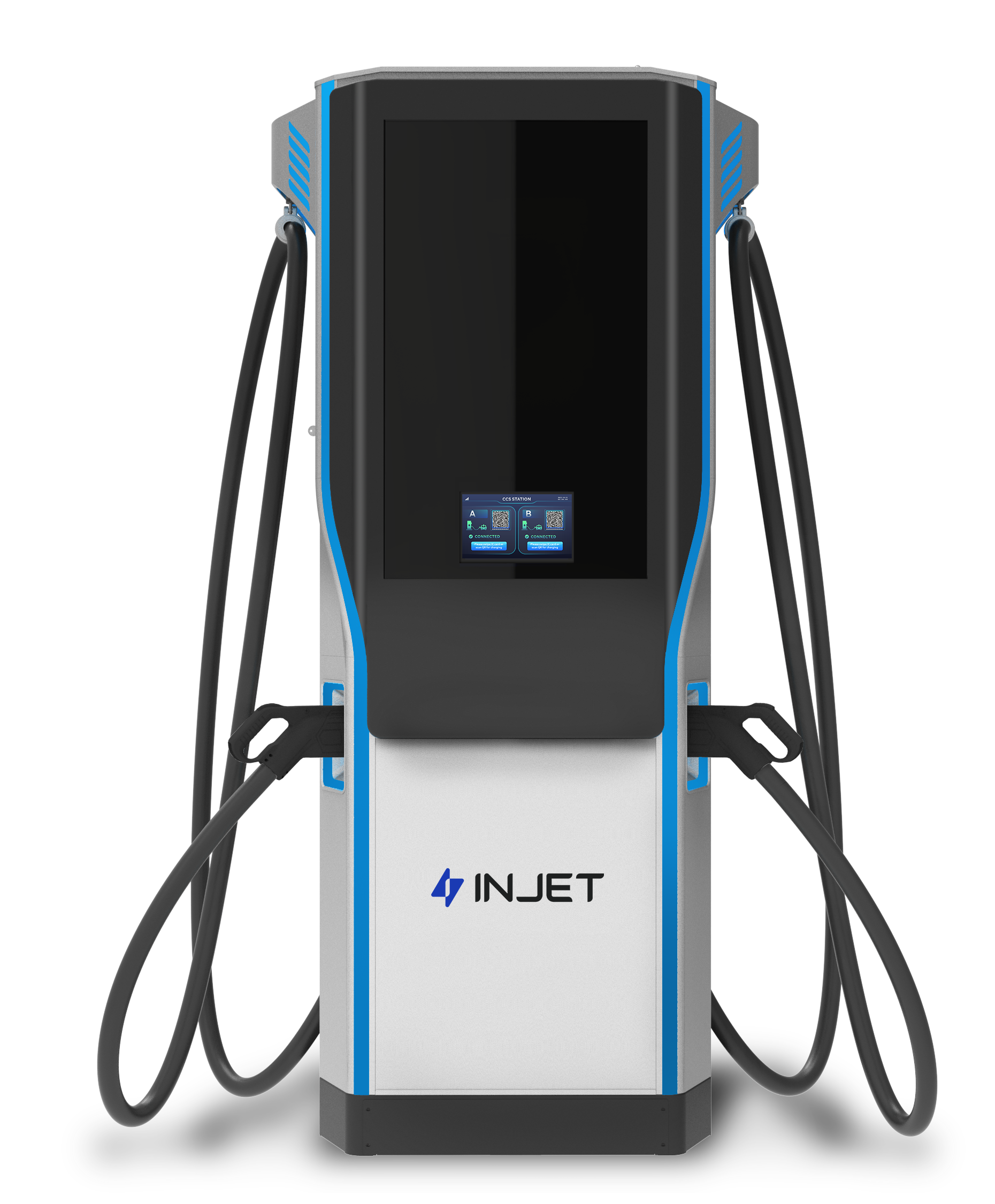
Where individual positions need higher DC output, the INJET Ampax Pro may be an option to evaluate. It offers up to 480 kW depending on configuration, although a vehicle’s actual charging rate may be lower. Where several positions need access to a shared power budget, the INJET Ampax Mega’s distributed architecture may be relevant. Any plan to add power equipment or terminals must be checked against the existing system configuration, electrical design and site capacity.
Injet also offers the separate Ampax DC charger range. Selecting among these systems should follow the depot assessment rather than the highest power rating on a product sheet.
If you are planning a depot expansion, share your vehicle count and models, daily energy recovery data, return and dispatch times, current charging equipment and available site information. Injet can use those details to discuss whether the existing setup is sufficient and what charging configuration may suit the next phase.
Explore Injet Energy’s fleet charging solution or contact the team to discuss your depot.