


The fleet economics are shifting faster than the infrastructure
A logistics operator running a 40-tonne truck on a 700km daily route between Munich and Hamburg consumes roughly 280 litres of diesel per round trip. At October 2024 diesel prices averaging €1.65/litre in Germany, that is €462 per day, or €120,000 annually for a five-day-per-week schedule. Maintenance adds another €18,000–€22,000 per year.
The electric truck burns approximately 200 kWh per 100km under highway load, translating to 1,400 kWh per round trip. At an industrial electricity rate of €0.18/kWh (off-peak charging with a favourable tariff), the energy cost drops to €252 per day, or €65,000 annually. Maintenance falls to roughly €8,000. Over a seven-year operating cycle, the gap between diesel and electric narrows considerably once you factor in purchase incentives, CO₂ penalties under EU fleet regulations, and the avoided volatility of diesel pricing.
But that calculation only holds if the truck can charge reliably at the depot overnight and access a 350kW+ public charger during the mandatory 45-minute break in Hanover. If the driver arrives to find the charger offline, queued, or incompatible with their vehicle’s CCS standard, the business case collapses into delay penalties and lost utilisation.
Infrastructure gaps are now more urgent than vehicle availability
Major European manufacturers have announced heavy-duty electric truck production schedules through 2027. The vehicles are arriving. What is missing is the corridor charging network capable of supporting multi-shift logistics operations across borders.
Unlike light commercial vans that return to a known depot each night, long-haul trucks operate on tight schedules with limited margin for delay. A 40-tonne truck on a scheduled delivery run does not have the flexibility to wait 30 minutes for a charger to become available or detour 50km off-route to find working infrastructure. Charging must be predictable, high-power, and integrated into existing rest-break patterns—or the truck stays diesel.
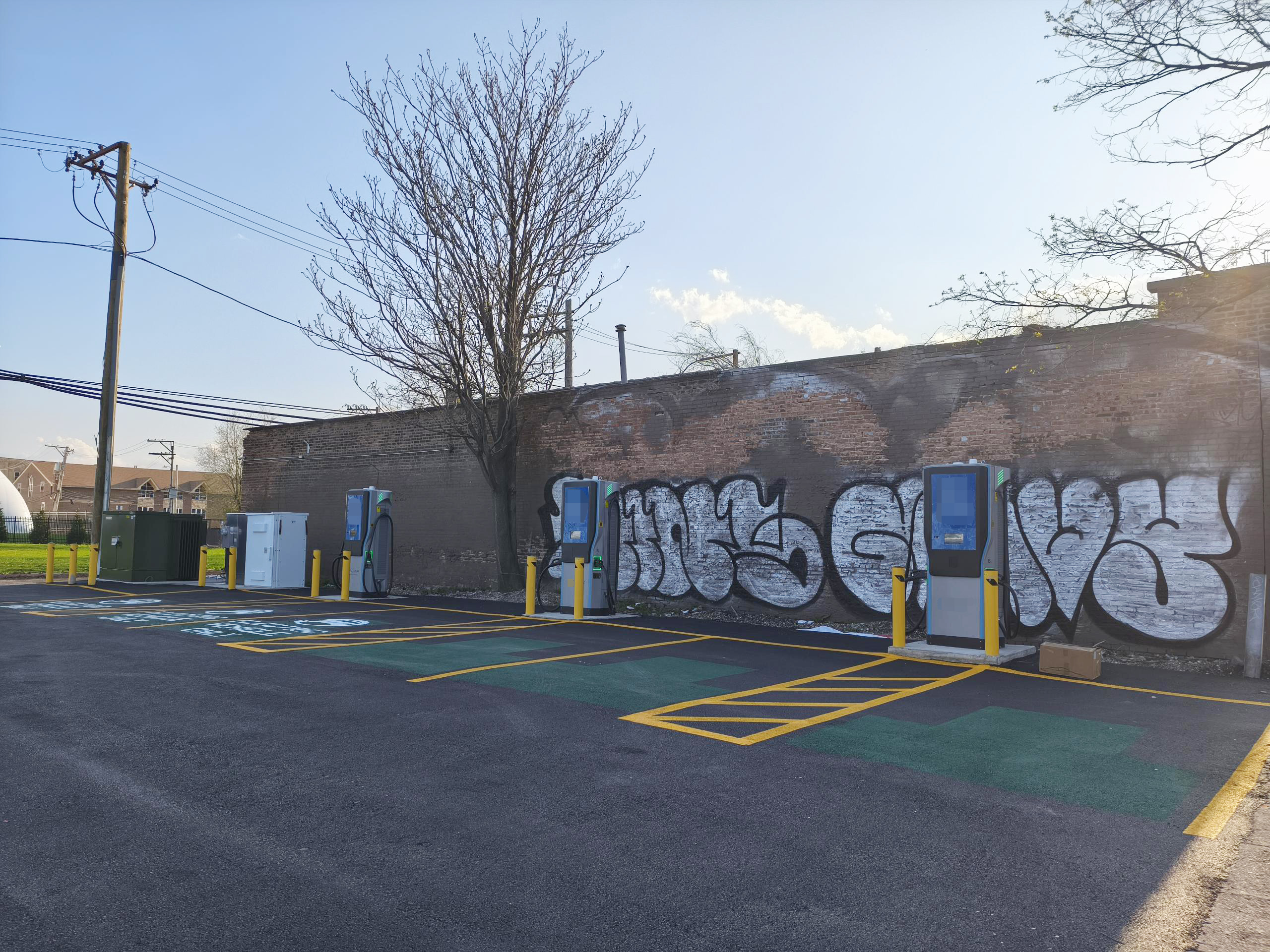
Injet Ampax deployed at a public charging site in the United States, demonstrating scalable high-power DC infrastructure for commercial fleets.
What “corridor charging” actually means in practice
A functional truck-charging corridor is not simply a line of chargers along a motorway. It requires:
- Site capacity: Grid connection sufficient to support 4–6 high-power dispensers operating simultaneously during peak hours (typically 1–3 MW total site demand).
- Power delivery: Chargers capable of sustained 350kW output to a single vehicle, allowing a truck to recover 300–400km of range during a 45-minute regulatory break.
- Vehicle compatibility: CCS2 and MCS readiness as the industry transitions to Megawatt Charging System standards for trucks over 500 kWh battery capacity.
- Uptime: Operational availability above 95%, with remote diagnostics and rapid service response. A 20% failure rate turns a charging site into a bottleneck.
- Payment and access integration: Roaming agreements or open-access payment systems so drivers do not need multiple accounts or RFID cards.
- Phased expansion: Site design that allows capacity additions without full reconstruction as fleet traffic increases.
Each of these layers—grid connection, equipment selection, site layout, software integration, and service infrastructure—has its own lead time and coordination burden. A CPO planning a truck-focused site in 2024 is designing for a fleet mix that will not fully materialise until 2027, using equipment standards that are still being finalised.
Fragmented policies complicate cross-border operations
European truck routes cross national borders, but grid connection timelines, permitting processes, public incentives, and electricity tariffs remain shaped by individual member states and regional authorities. Germany’s industrial electricity rates differ significantly from France’s nuclear-backed pricing. Poland’s permitting timelines for high-power grid connections are longer than the Netherlands’. Italy’s public charging incentives favour passenger vehicles over commercial freight infrastructure.
This fragmentation increases planning risk for both CPOs and fleet operators. A truck manufacturer can certify a vehicle for EU-wide operation, but the charging network remains uneven from one region to the next. Network operators like Milence (the Daimler-Traton-Volvo JV) have noted in their public analysis that regulatory inconsistency is one of the key barriers to corridor development, particularly around site permitting and grid upgrade coordination.
Equipment selection determines what a site can do in 2027, not just today
High-power DC charging platforms are not interchangeable. When evaluating equipment for a truck-focused site, operators need to assess:
- Maximum sustained power per dispenser under thermal load (not just peak nameplate rating)
- Multi-output flexibility (can the platform split power dynamically between dispensers based on vehicle demand?)
- Future-proofing for MCS and higher-voltage battery architectures
- Remote diagnostics and firmware update capability
- Maintenance access and mean time to repair (MTTR)
- Scalability—can you add dispensers or upgrade power modules without replacing the entire platform?
A charger rated at 400kW that can only sustain 280kW under continuous operation in summer heat is effectively a 280kW charger. A platform that requires an on-site technician visit for every software update will struggle to maintain uptime across a distributed network. These details matter more than the numbers in a product brochure.
Where Injet Ampax fits into the infrastructure layer
Injet Ampax is a high-power DC charging platform designed for public corridor charging and commercial depot operations. It delivers up to 480kW of sustained output per dispenser, with dynamic power allocation across multiple outputs and modular scalability to accommodate site expansion as fleet traffic grows.
For CPOs planning truck-focused sites, Ampax is part of a broader infrastructure stack that includes grid capacity planning, site layout, networking, and service response. The platform supports CCS2 today with MCS upgrade readiness, includes remote diagnostics and over-the-air firmware updates, and is built for thermal performance in continuous-use scenarios.
Ampax is not a substitute for grid connection or permitting, but equipment selection is one of the layers that determines whether a charging site can scale with demand or becomes a bottleneck in two years. Technical specifications and deployment case studies are available here.
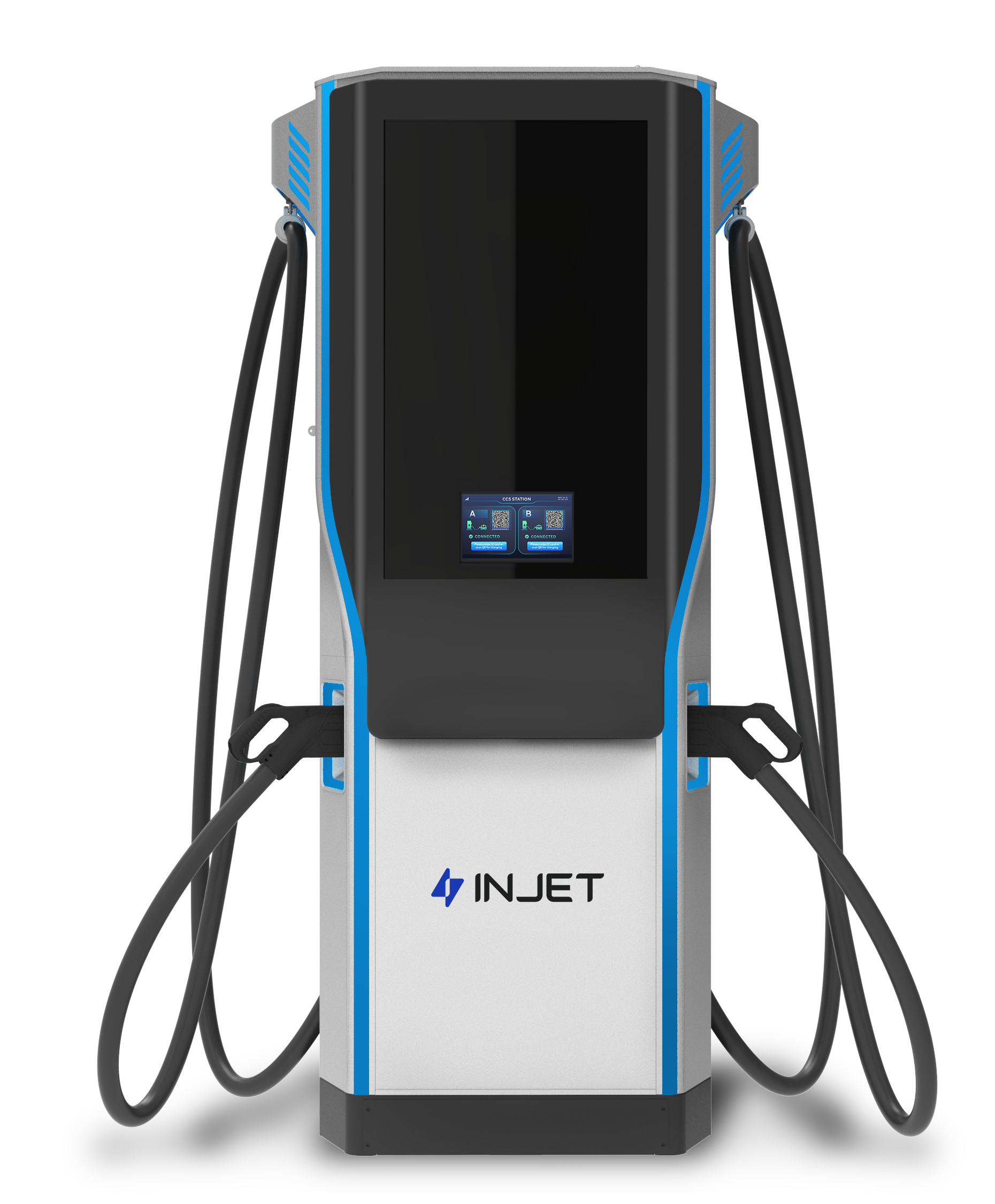
Injet Ampax high-power DC charging platform.
The next phase is operational reliability at fleet scale
The electric truck business case is increasingly practical for predictable routes, scheduled depot charging, and fleets that can absorb the upfront capital cost over a 7–10 year cycle. What is not yet practical is relying on a public charging network that is incomplete, unevenly distributed, and—in some regions—operationally immature.
Europe’s next challenge is execution: building corridor charging infrastructure that is high-power, operationally reliable, and expandable across a fragmented regulatory landscape. Fleet adoption will not be determined by vehicle announcements. It will be determined by whether a driver on a scheduled run can pull into a rest stop in Hanover, plug in during their mandatory break, and leave on time with enough range to complete the route. That is the infrastructure problem still being solved.