


Experience and feedback from my partners suggest that many Charge Point Operators (CPOs) are unknowingly leaving money on the table. Despite securing high-capacity grid connections and investing in premium distributed charging systems, many still find their site’s actual throughput surprisingly sluggish.
The industry is rapidly scaling, but many operators are walking straight into the “Power Island” trap. The reality is painful but evident: installed capacity does not equal earning capacity. If your architecture is rigid, you are quite literally watching money leak out of your pocket.
1. The “Power Island” Trap: Idle Power is Dead Money
Imagine a typical scenario at your charging station:
You have a 2MW site equipped with four 480kW power cabinets, each connected to three dispensers.
-
Cabinet A is occupied by an electric heavy-duty truck and two premium SUVs with a low Battery State of Charge (SOC), “starving” for every kilowatt available to stay on schedule.
-
Cabinets B, C, and D are charging passenger vehicles that have already reached 80% SOC or have limited onboard charging rates. These cars might only require 40kW (or even less) at this moment.
The Problem: A massive “Idle Power Pool” that goes to waste.
In this scenario, a significant amount of electricity is sitting idle, yet it cannot be redirected to the “starving” vehicle at Cabinet A. On paper, you have a 2MW power reserve and are paying for a massive grid connection, but in reality, this inefficiency is bleeding your bottom line.
How does this happen?
Look at it from a different perspective: the total electricity you can provide is a fixed daily capacity. If you only sell 480kW in an hour when you theoretically could have sold 600kW, that “lost” 120kW represents invisible lost revenue. If we value electricity at $1 per kW (as a simplified example), you have effectively lost $120 in just one hour for a single power cabinet.
2. Is There Any Way to Fix This Situation?
Yes.
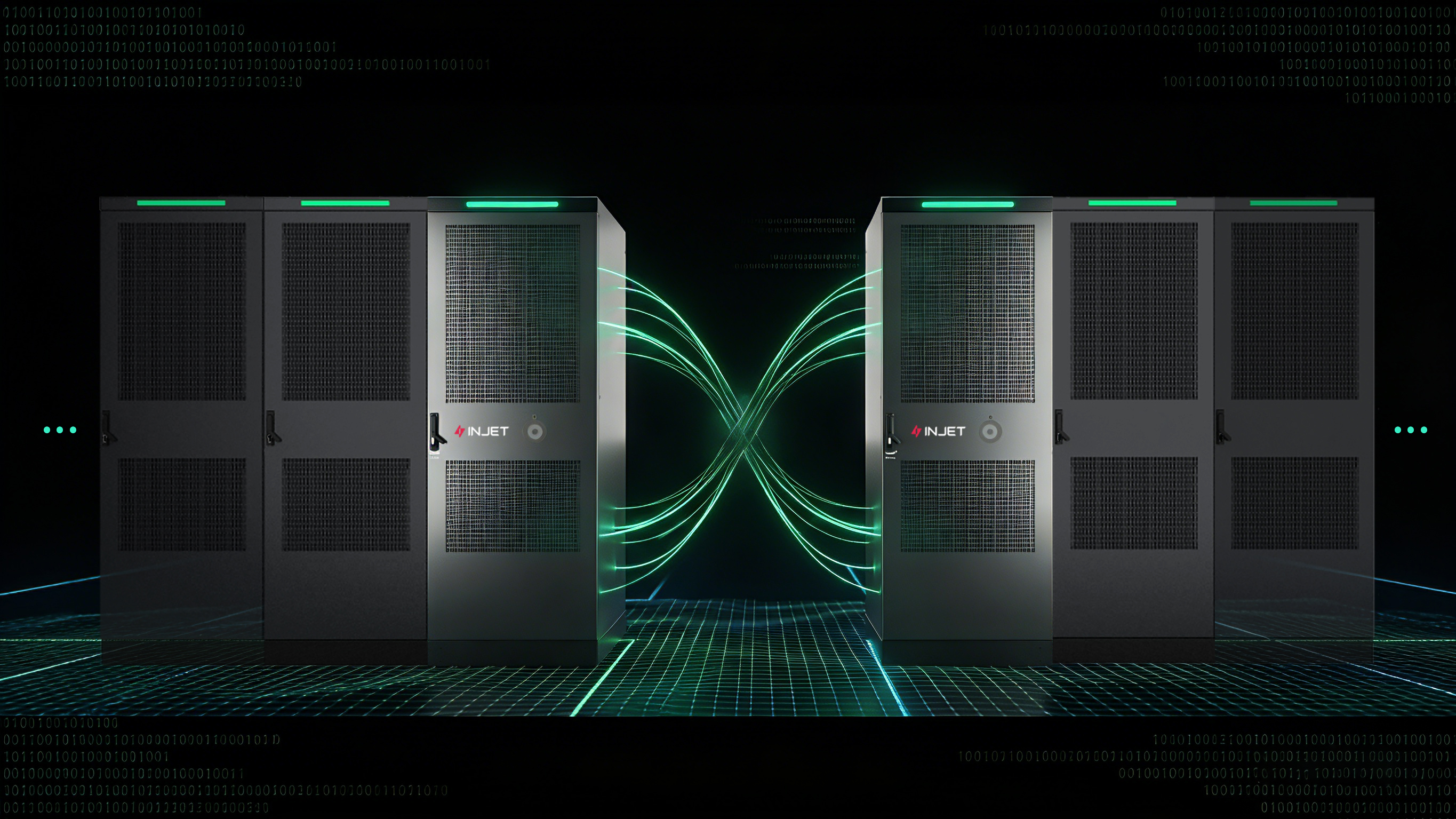
At Injet, we have developed a dedicated solution specifically to address this inefficiency. When we developed the Injet HanYuan distributed charging system, we didn’t just want more power; we wanted smarter utilization. We redefined the architecture to create a unified system.
-
Breaking the Silos: Our power cabinets utilize a unique modular design that eliminates the barriers between individual units.
-
Total Connectivity: Unlike traditional setups, our system allows every power distribution module of each power cabinet to function as part of a single, cohesive whole.
-
Smart Intelligence: This hardware foundation enables our Intelligent Global Power Scheduling Algorithm.
True 2MW Utilization & Massive Throughput
By combining unique hardware with smart software, our system can scale from 480kW to 1,920kW in total output. This means your 2MW capacity is not just a figure “on paper”—it is fully accessible and usable. For operators, this translates to the ability to fully monetize your entire grid connection, especially during peak traffic when every minute of throughput counts.
3. The Hidden Cost: Why Efficiency Matters
In reality, every power module inside a charging station has a “Golden Efficiency Zone.” One of the most important things to verify before choosing an EV charging station supplier is their Efficiency Curve.
For those new to the field, System Efficiency represents how effectively electricity is drawn from the grid and delivered to the vehicle. For example, if you purchase 100kWh of electricity from the grid and your EVSE (Electric Vehicle Supply Equipment) has a 97% efficiency rating, only 97kWh actually reaches the driver’s battery. That 3% difference is a direct operational cost—electricity you paid for but cannot sell.
The “Full Load” Trap
Many EV charger manufacturers will claim their systems can reach 97% efficiency. However, they often omit that most chargers cannot maintain that efficiency while working at full load.
In fact, the system performs best when working at a 60–80% load. Within this “Sweet Spot”:
-
Internal components operate within their optimal thermal and linear regions.
-
Heat generation remains controllable (less energy is wasted as heat).
-
The control loop response is at its most precise, achieving peak conversion efficiency.
The Injet HanYuan Advantage
Our system centrally coordinates every module within every power cabinet across the entire facility. Instead of pushing a few modules to 100% capacity (where they become inefficient), HanYuan automatically directs idle modules to share the load.
By ensuring the hardware operates within that 60–80% load range, we maximize efficiency and minimize power loss. With HanYuan, an improvement of 1%–1.5% in overall system efficiency is achievable. For a high-traffic site, that 1.5% isn’t just a number—it’s pure profit recovered from wasted heat.
4. Conclusion: How Much Could You Have Saved?
Let’s look at a conservative baseline for a 2MW charging site with a minimum daily throughput of 8,000 kWh. Assuming a loss of just 120 kWh in “trapped” idle electricity per day and a 1% efficiency gap, here is the breakdown of your daily revenue leakage:
Daily Revenue Leakage Analysis
| Loss Category | Energy Lost (Daily) | Revenue Lost (Daily @ $0.50/kWh) |
| Trapped Idle Power | 120 kWh | $60 |
| Efficiency Gap (1%) | 80 kWh | $40 |
| Total Daily Loss | 200 kWh | $100 |
The Compounding Cost of Inefficiency
A loss of $100 per day may seem small for a large facility, but it scales quickly:
-
Monthly Revenue Loss (30 Days): $3,000
-
Annual Revenue Loss (365 Days): $36,500
By choosing a distributed charging system like Injet HanYuan, you are recovering over $36,000 in lost profit every year for a single 2MW site. Stop letting your grid connection bleed revenue—start monetizing every kilowatt today.
Note: This analysis is part of our global charging efficiency series. For a specialized look at the UK’s specific grid constraints and ROI calculations, please refer to the original regional report on our UK EV Charging Resource Center.
Stop Bleeding Revenue and Start Monetizing Every Kilowatt
Don't let your grid connection bleed revenue anymore. With the Injet HanYuan distributed charging system, you can recover over $36,000 in lost profit every year for a single 2MW site.
Maximize Your Site's ROI — Contact Us TodayReady to escape the "Power Island" trap? Our experts are standing by to help you optimize your earning capacity.

Frequently Asked Questions
- Previous:
- Next: What is the new Measuring Instruments Directive (MID)?