


How charging capability should be acquired once the vehicle strategy is defined
In the previous article, we discussed several ways companies can acquire electric vehicles: purchase, leasing, FaaS, sharing, and retrofitting. The conclusion was straightforward — electrification is not a one-off procurement decision, but a long-term set of choices concerning assets and risk.
Once the vehicle strategy becomes clearer, companies will quickly encounter a more immediate and practical question:
How should charging capability be acquired — through self-building, leasing, outsourcing, or not owning it at all?
This article focuses precisely on that question.
Without discussing specific equipment models, it systematically reviews the main paths through which companies can acquire charging capability, along with the costs, responsibilities, and long-term constraints associated with each path.
(Image Source: ElectriEASE)
Comparing the main paths to acquiring corporate charging capability
In a corporate context, charging is not a single engineering issue, but a management decision involving investment structure, operational responsibility, and long-term controllability.
The differences between acquisition paths are often more decisive than the equipment itself.
Comparison of charging capability acquisition paths
|
|
Advantages |
Disadvantages |
Typical scenarios |
|
Self-built and self-operated (Company purchases and operates charging infrastructure) |
l Full control over assets and usage rules l Flexible planning aligned with fleet size l Predictable long-term unit charging costs l Easy integration with corporate energy and mobility strategies |
l High upfront investment (equipment, power capacity, construction) l Full responsibility for operations, compliance, and upgrades l High requirements for internal management and technical capability |
Vehicles mainly purchased or under long-term lease Stable and predictable usage demand Company has a long-term operational commitment |
|
Equipment purchase with outsourced operations
(O&M model) |
l Retains asset ownership while reducing operational complexity l Relatively stable service quality l No need to build an in-house operations team |
l Higher total cost than full self-operation l Certain dependence on service providers l Flexibility constrained by service contracts |
l Large fleets without the intention to build an internal O&M team l Stable vehicle usage but limited internal resources |
|
Leasing / subscription-based charging solutions (Charging as a Service) |
l Low upfront capital expenditure l Construction, operations, and software usually bundled l Fast deployment |
l Higher long-term cost l Assets not owned by the company l Limited room for adjustment |
l Fleet still in pilot or transition phase l Vehicles acquired via FaaS or subscription models l Future scale remains uncertain |
|
Third-party investment and construction |
l Minimal upfront investment by the company l Construction and operational risks borne by third parties l Suitable for open-access environments |
l Limited control over usage rules l Service priority not fully controllable l Difficult to fully align with internal fleet rhythms |
l Parking facilities open or semi-public l Charging primarily for visitors or customers l Charging not considered a core capability |
|
Fully externalized
(Reliance on public or social charging networks) |
l No construction or operational burden l High flexibility |
l Uncontrollable cost and availability l Inconsistent user experience l Not scalable |
l Low-frequency or non-core vehicle usage l Supplementary or transitional solution l Not suitable as a primary strategy |
Why companies eventually engage directly with manufacturers at scale
Across the different paths to acquiring charging capability, companies will eventually encounter a practical turning point:
Once deployment scale and operational timelines extend, procurement channels themselves begin to influence total cost and controllability.
For companies with limited deployments or still in an exploratory phase, purchasing charging equipment through local distributors is often more flexible, less demanding, and easier to implement.
However, when companies begin multi-site deployments and treat charging as a long-term operational capability, the decision focus usually shifts — from “convenience” to “sustainability.”
It is at this stage that companies naturally start engaging directly with manufacturers.
(Image Source: GO TO-U)
INJET’s positioning in this context
INJET’s role becomes relevant precisely under these conditions.
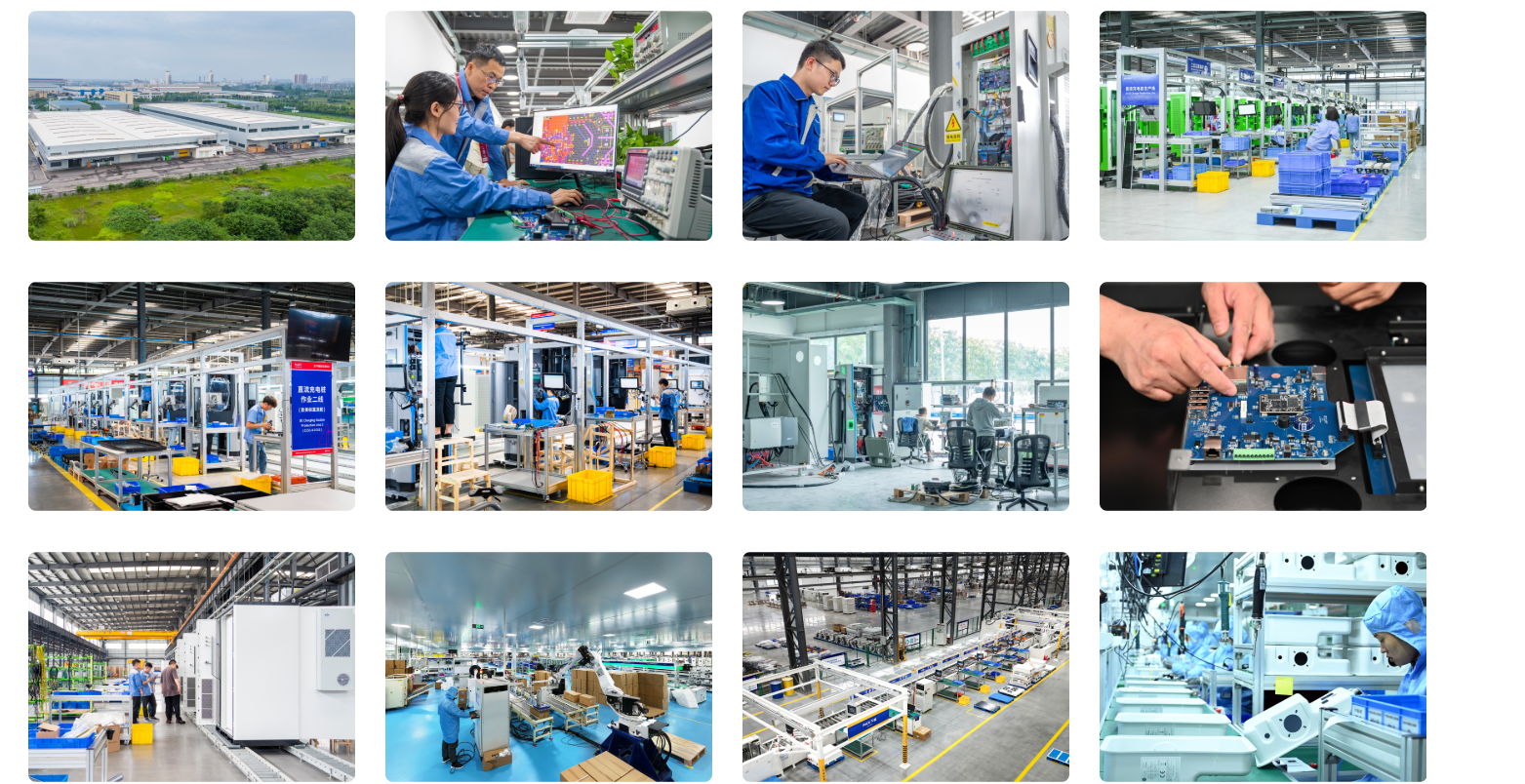
As a charging equipment manufacturer, INJET does not attempt to define a company’s electrification path. Instead, it serves companies that have already made a clear decision to own or manage charging assets over the long term.
In such scenarios, the value of a manufacturer is primarily reflected in three areas:
1)Structural advantages in total cost of ownership (TCO):
Decision-making extends beyond the unit price of equipment to include procurement, maintenance, replacement, and technological evolution over the full lifecycle.
2)Consistency and customization capability:
Support for private labeling and customization helps companies maintain system consistency across multi-site deployments, rather than assembling equipment from disparate sources.
3)Coordination with local execution ecosystems:
Manufacturers do not replace local installers or after-sales providers, but work through partner networks to deliver stable, repeatable deployment and technical support.
It should be noted that this is not a path suitable for all companies.
For smaller organizations or those with uncertain demand, distributor-based solutions or subscription models are often more appropriate. However, once companies enter a phase of scale and long-term operation, whether to establish a direct relationship with manufacturers becomes an unavoidable decision with lasting implications.
In corporate projects, the real challenges often arise after delivery.
Long-term technical support, product evolution, and system compatibility frequently prove more valuable than a one-time deployment.
Conclusion
From self-building to outsourcing and full externalization, corporate choices around charging capability may appear technical or solution-driven, but in reality reflect trade-offs between responsibility, control, and long-term operating models.
As with vehicle acquisition strategies, there is no one-size-fits-all solution for charging capability. A more pragmatic approach is to select models that match a company’s scale and maturity at each development stage, while preserving room for future adjustment.
When companies recognize this, charging is no longer a “supporting infrastructure,” but a management decision that deserves deliberate consideration.