


As of early 2026, the US has surpassed 200,000 public charging ports, yet a significant challenge remains: Reliability. For operators of ev charging public networks, the focus has shifted to the Federal 97% uptime mandate—a goal that many traditional chargers struggle to meet due to internal complexity.
The "Wire Trap": Why Traditional DC Chargers Fail
Traditional DC chargers are often a "bird's nest" of over 280 individual cables and connectors. In a high-vibration, high-heat outdoor environment, each one of those 280 wires is a potential failure point. In the US, where skilled electrical labor is a premium, this "internal chaos" leads to skyrocketing maintenance costs and failed uptime mandates.
Introducing Injet Ampax: The "89-Wire" Revolution
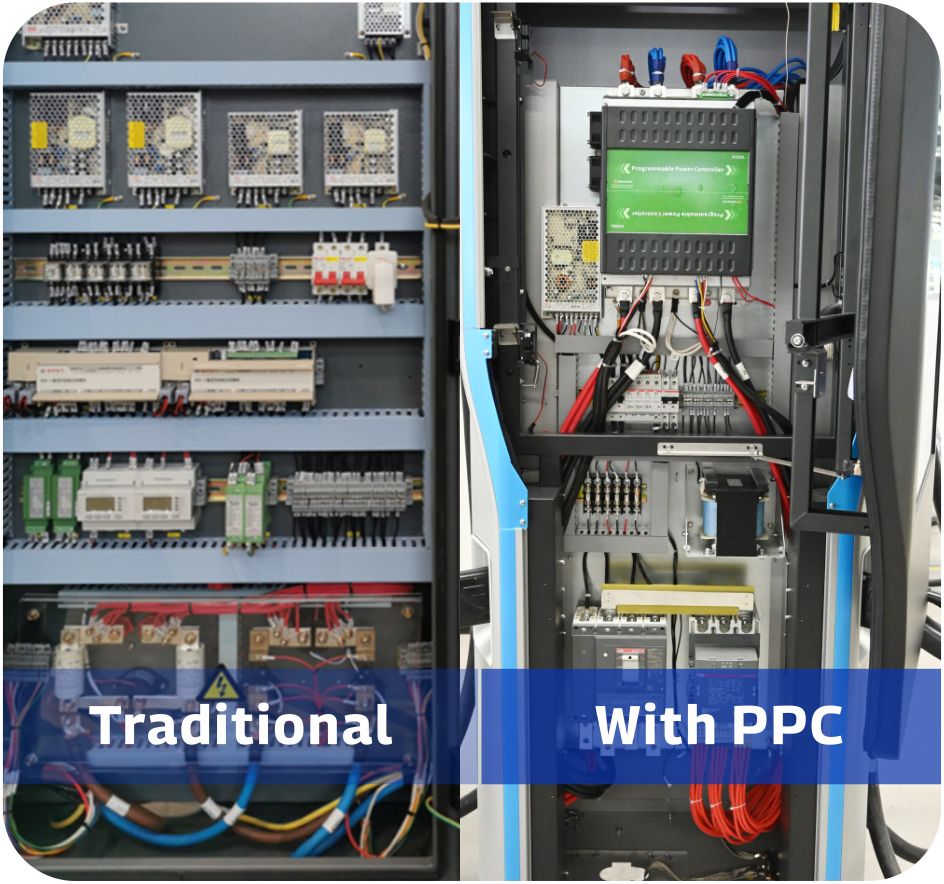
Injet AMAPX vs. Traditional Charging Station Internal Structure
The Injet Ampax was engineered to redefine the internal architecture of the ev fast charger. We’ve achieved a breakthrough by moving away from cluttered, old-school designs to a streamlined, modular core centered around our Integrated PPC (Programmable Power Controller).
The "Green Box" Advantage
At the heart of every Injet Ampax sits the PPC—our signature "Green Box." This hardware module integrates core circuit boards, contactors, and protection logic that used to be scattered across the cabinet.
-
Radical Simplification: We have slashed internal cabling from 280 wires down to just 89.
-
Failure Point Elimination: By removing over 190 manual connection points, we’ve eliminated 70% of the most common hardware failure triggers.
-
Serviceability for 2026: The "Green Box" allows for rapid modular swaps, keeping your station online and compliant with federal standards.
Navigating the "Hybrid Grid": Your Strategy for Tesla EV Charger Compatibility
2026 is the year of the "Hybrid Grid." While most new 2026 model-year EVs now feature native SAE J3400 (NACS) ports, millions of CCS1 vehicles remain on the road. For site hosts, providing a seamless tesla ev charger experience while supporting legacy vehicles is the top priority.
Unified Hardware Platform for NACS & CCS1
Because the Green Box PPC handles the universal power distribution logic, the Ampax is a unified hardware platform. This means whether your next 2026 deployment is NACS-native or dual-standard, the internal PPC architecture remains identical, drastically reducing your spare parts inventory and technician training costs.
2026 Industry Standards & Regulatory Context
To ensure your ev charging public investment is future-proof, we align with the latest 2026 federal guidelines:
-
NEVI 2026 Compliance: The Federal Highway Administration recently reaffirmed the 97% uptime requirement for all NEVI-funded projects. .
-
SAE J3400 (NACS) Finalized: As of early 2026, the industry has fully shifted toward the finalized SAE J3400 standard for a unified tesla ev charger experience. .
-
Buy America 2026: New proposals emphasize domestic content requirements for federally funded EVSE. .
FAQ: Understanding the Injet Ampax & Modular PPC Advantage
Q1: How does the Injet Ampax improve reliability compared to traditional chargers?
A: Most ev fast charger failures are caused by complex internal wiring. Traditional designs use over 280 individual cables, creating hundreds of potential failure points. The Injet Ampax features a patented Integrated PPC (Green Box) that slashes internal cabling to just 89 wires. By reducing physical complexity by 70%, we significantly minimize downtime and ensure stable performance for ev charging public networks.
Q2: Is the Injet Ampax compliant with US NEVI regulations in 2026?
A: Yes. The Federal NEVI program requires a strictly monitored 97% uptime. The Ampax is engineered specifically for this mandate. Its modular architecture allows for "plug-and-play" maintenance—if a core component has an issue, the integrated PPC module can be swapped quickly, ensuring your station remains online and eligible for federal funding.
Q3: Does the Injet Ampax support a "Tesla EV Charger" experience?
A: Absolutely. While the US market transitions to the NACS (SAE J3400) standard, the Injet Ampax provides the hardware flexibility needed for this era. We offer configurations for both NACS and CCS1. Because the internal power logic is handled by the unified Green Box PPC, your fleet will benefit from a consistent charging experience regardless of the connector type.
Q4: What exactly is the "Green Box" PPC?
A: The PPC (Programmable Power Controller) is a shielded, integrated hardware module that acts as the "brain and heart" of the charger. It consolidates high-wear components like core circuit boards, contactors, and protection sensors into one unit. This modularity means that instead of troubleshooting a "bird's nest" of wires, technicians can focus on a single, easy-to-service module.
Ready to Future-Proof Your Charging Infrastructure?
Contact our experts today to learn more about the Injet Ampax and how our modular PPC technology can lower your TCO.
Get a Quote Now