


Across North America and Europe, fleet electrification is accelerating at an unprecedented pace—from long-haul trucks operated by logistics giants to municipal service and construction vehicles. Yet one critical bottleneck continues to limit this transition: traditional high-power charging solutions rely on bulky, heat-prone cables that are difficult to handle and constrained by thermal limits under sustained loads. To fully unlock the potential of heavy-duty electric vehicles, charging technology itself must evolve. This is where liquid-cooled ultra-fast charging steps decisively into the spotlight.
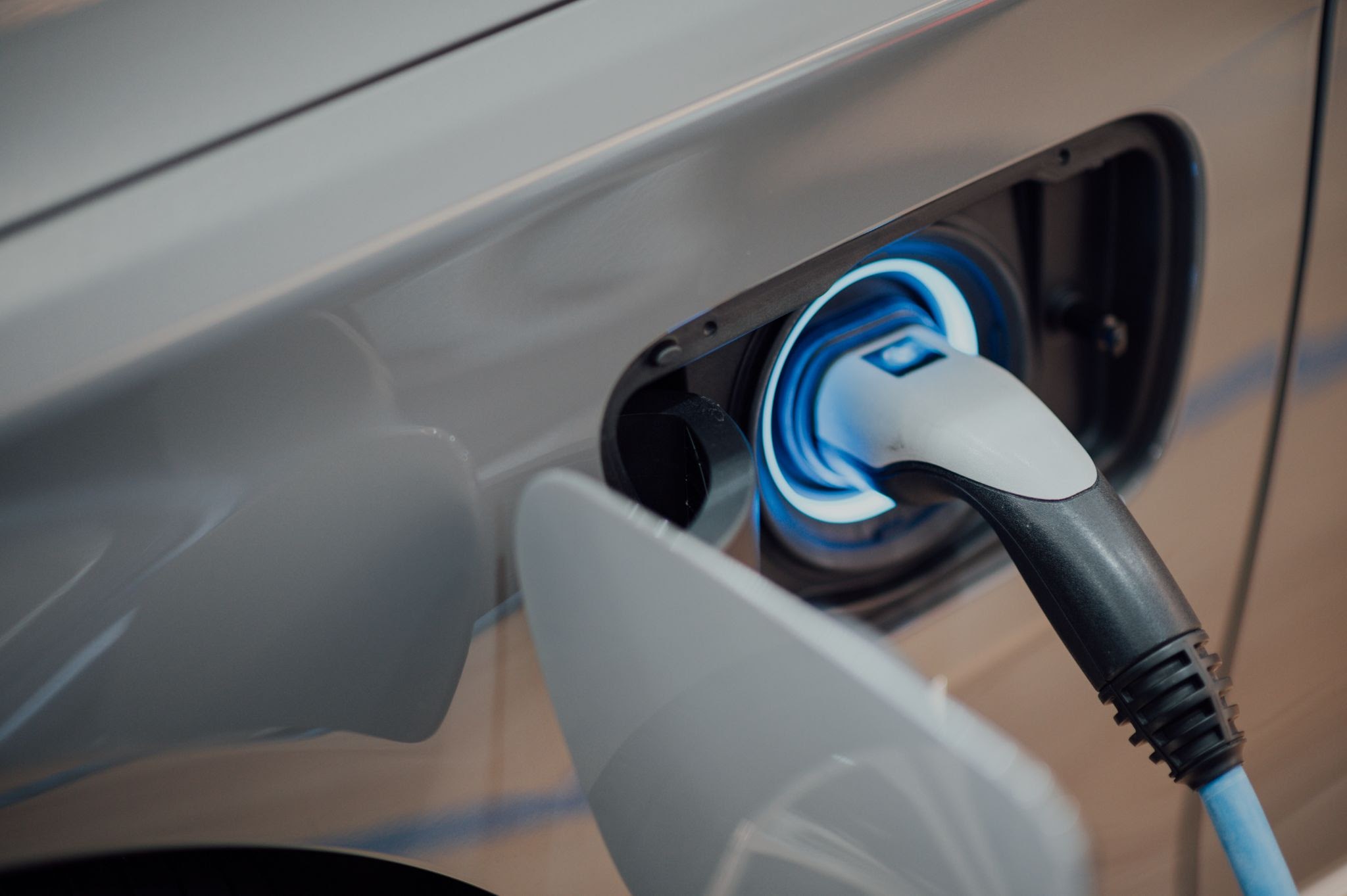
(Image Source: Heliox)
Why Air Cooling Has Reached Its Limits
The fundamental equation behind charging power is straightforward:
Power (kW) = Voltage (V) × Current (A).
While 800V high-voltage platforms are becoming the industry standard, achieving truly ultra-fast charging depends primarily on pushing current levels to 400A, 500A, or even higher.
However, high current inevitably generates significant heat. At sustained outputs above 500A, resistive heating inside the cable rises sharply. Traditional air-cooling methods, which rely on passive heat dissipation, struggle to cope—leading to several critical issues:
- Excessively thick and heavy cables
To accommodate larger conductors and allow for passive cooling, cable diameter and weight increase dramatically, making single-person operation impractical. - Forced power derating
To prevent overheating and equipment damage, chargers often reduce output power after only a few minutes at peak current—resulting in fast starts followed by slower-than-expected charging. - Safety risks and accelerated wear
Prolonged high-temperature operation accelerates aging of cables and connectors, increasing failure rates and maintenance costs.
Liquid-Cooled Ultra-Fast Charging: A Smarter Solution
Liquid cooling addresses these challenges through active thermal management. Rather than relying on airflow alone, it uses a closed-loop coolant system to precisely control heat at its source. The concept is elegant and highly effective:
- Integrated cooling circuits
In addition to power conductors, the charging cable incorporates narrow coolant channels. - Targeted heat removal
Coolant is pumped directly to areas with the highest thermal load—specifically the charging gun terminals and cable conductors. - Continuous heat exchange
Heated coolant flows back to a heat exchanger inside the charger, where heat is dissipated before the cooled liquid recirculates.
This closed-loop approach delivers transformative benefits:
- Lighter, thinner, yet more powerful cables
With coolant handling most of the thermal load, conductor cross-sections can be reduced. Cable weight can drop by up to 40%, enabling easy single-operator handling even at ultra-high currents. - Sustained peak power output
Active cooling keeps cables and connectors at safe temperatures, allowing chargers to maintain maximum output for extended periods without derating. - Superior safety and durability
Stable low-temperature operation significantly enhances system reliability and component lifespan, supporting operation in environments ranging from Nordic winters to Middle Eastern heat.
Why Liquid-Cooled Charging Is Becoming Essential
The value of liquid cooling is especially evident in high-demand scenarios:
- Heavy-duty commercial vehicles
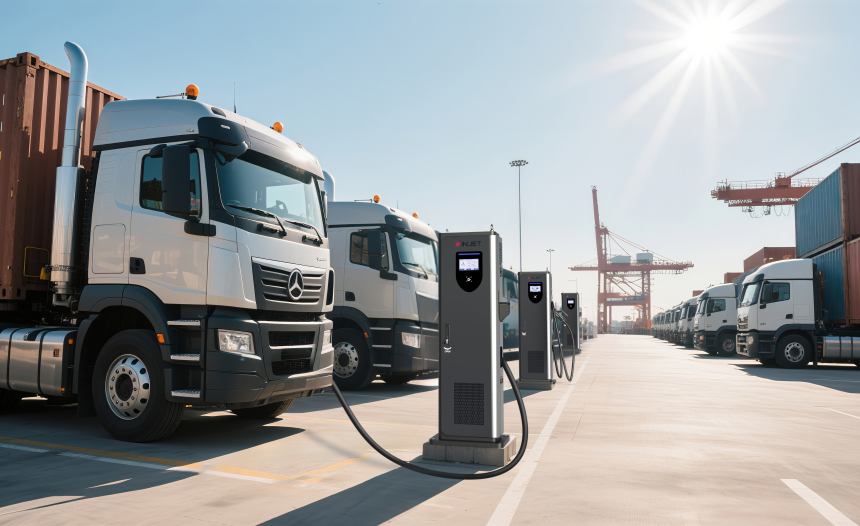
Electric trucks, mining vehicles, and buses often carry batteries in the 400–600 kWh range. Delivering hundreds of kilometers of range within tight operational windows—such as a driver’s mandatory 30-minute rest period—requires sustained currents well above 600A. Liquid cooling is the only viable solution for this endurance-level performance. - High-frequency fleet operations
Vehicles at logistics hubs, ports, and mining sites may need to recharge multiple times per day. The reliability and efficiency of liquid-cooled ultra-fast charging are foundational to maintaining fleet uptime and operational efficiency. - Next-generation ultra-fast charging networks
As passenger vehicle batteries evolve, charging power is moving beyond 400 kW. Liquid cooling is the technological backbone of future public charging networks designed to deliver refueling experiences comparable to conventional fuel stations.
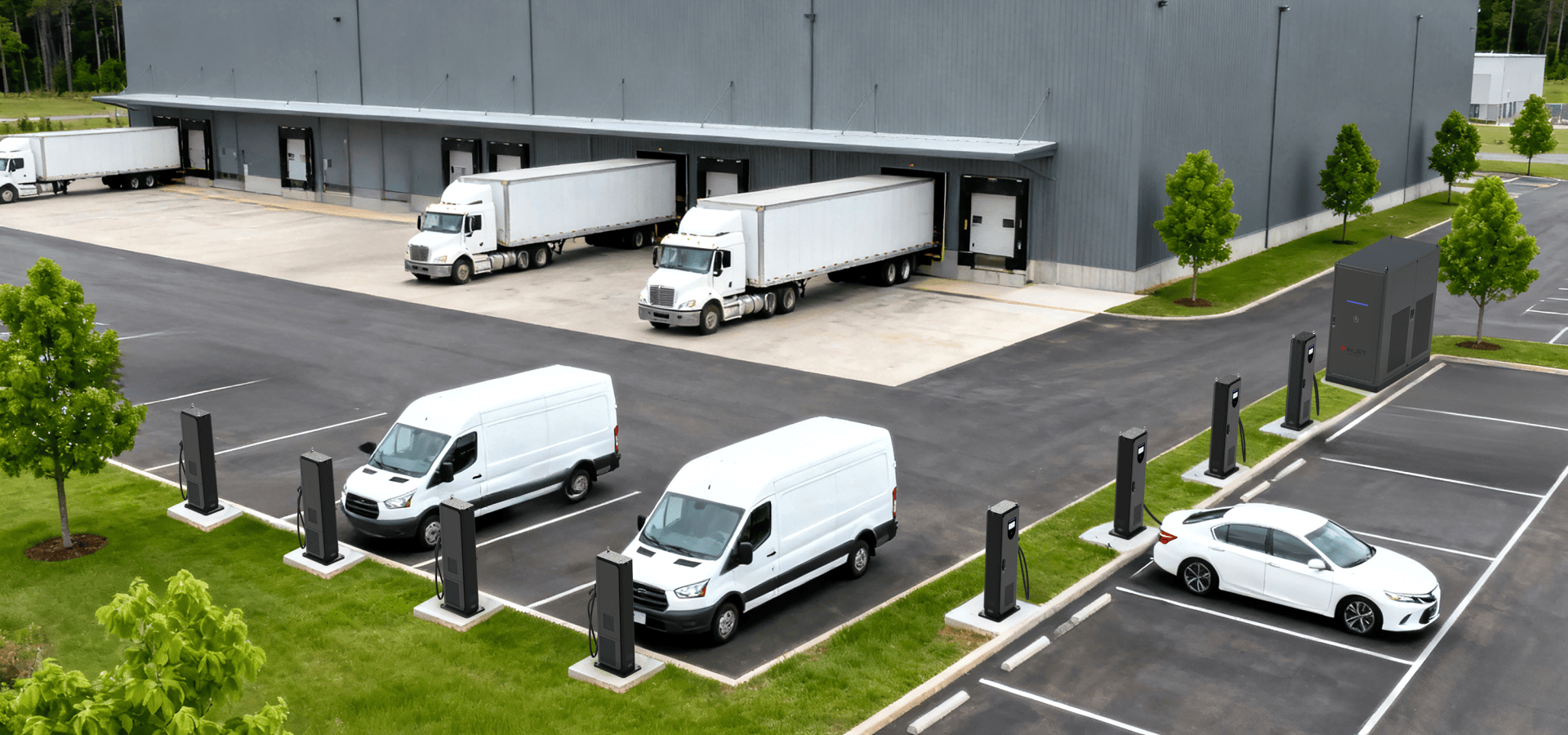
INJET New Energy in Practice
Recognizing the diverse demands of real-world charging scenarios, INJET New Energy has introduced an innovative hybrid ultra-fast charging station solution, anchored by its flagship Injet Ultra liquid-cooled ultra-fast charging system.
The Injet Ultra power stack, paired with precision-engineered liquid-cooled charging terminals, has been rigorously tested to deliver a stable 600A output for over 20 minutes. This makes it ideally suited for heavy-duty trucks, mining vehicles, and other applications that demand sustained high power without compromise. During valuable vehicle downtime, energy is delivered at maximum efficiency—without performance loss due to overheating.
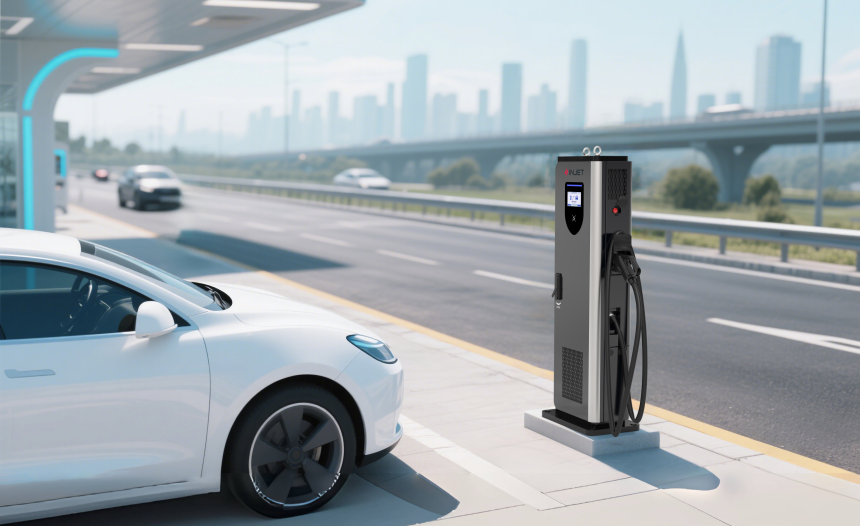
Equally important, INJET New Energy offers charging station operators unmatched flexibility. A single INJET ultra-fast charging site can be configured with both air-cooled and liquid-cooled terminals:
- Air-cooled terminals for passenger vehicles, providing a cost-effective solution for everyday fast charging needs.
- Liquid-cooled terminals for heavy-duty vehicles or users seeking the highest charging speeds and premium performance.
This dual-mode architecture allows operators to allocate resources intelligently based on traffic patterns and vehicle mix, maximizing return on investment while remaining fully prepared for future charging demands.
Conclusion
For fleet operators, investing in liquid-cooled ultra-fast charging infrastructure means predictable turnaround times and higher operational reliability. For charging network operators, it represents a decisive step toward building future-ready sites capable of serving all vehicle classes.
By combining top-tier liquid-cooling performance with a flexible hybrid air-cooled/liquid-cooled architecture, INJET New Energy is empowering global partners to move confidently toward an all-electric future—efficiently, reliably, and at scale.