


Choosing the right EV charging connector is one of the first things that trips up new electric vehicle owners — and even experienced drivers get confused as standards continue to evolve. With multiple plug formats, incompatible protocols, and a rapidly shifting landscape in North America, understanding what goes into your car is no longer optional. It’s essential.
This guide walks you through every major connector standard in use today, explains the difference between AC and DC charging, and helps you figure out which plug type actually applies to your situation — whether you’re shopping for a home charger, planning a road trip, or evaluating public charging infrastructure.
Why Connector Compatibility Matters
Not all charging plugs are created equal. Unlike gasoline nozzles, which are essentially universal, EV charging hardware is fragmented across regions, manufacturers, and power levels. Using the wrong connector type — or buying a charger that doesn’t support your vehicle’s onboard system — means either a failed session or a damaged port.
Beyond individual compatibility, the connector standard your vehicle uses also determines:
- 1)Which public charging stations you can access
- 2)What maximum charging speed your setup can deliver
- 3)Whether you’ll need an adapter for cross-network compatibility
- 4)How future-proof your home charging equipment will be
For fleet operators and site hosts investing in charging infrastructure, connector selection directly affects utilization rates and ROI.
AC vs. DC Charging: The Foundation You Need First
Before diving into specific plug formats, it helps to understand the fundamental split between AC and DC charging — because each connector type belongs to one or the other.
AC charging (Alternating Current) uses the same electricity supply as your home grid. The conversion from AC to DC — which is what actually charges the battery — happens inside the vehicle via its onboard charger. This is inherently slower because the onboard unit has a fixed power limit, typically between 3.7 kW and 22 kW depending on the car.
DC fast charging (Direct Current) does the conversion outside the vehicle, in the charging unit itself. Because the station handles the heavy lifting, it can deliver much higher power directly to the battery — commonly 50 kW to 350 kW. This is what makes rapid top-ups on motorways and highway corridors possible.
Understanding this distinction matters because the connector physically reflects the charging method — AC and DC plugs are fundamentally different shapes and cannot be swapped.
EV Charging Connector Types: A Full Breakdown
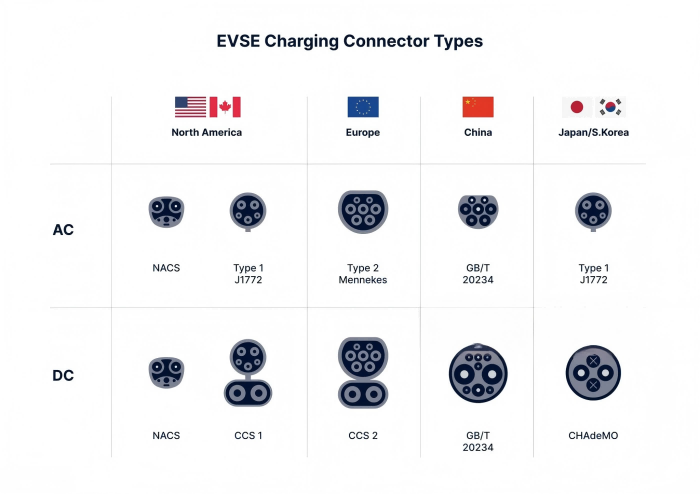
1. SAE J1772 (Type 1) — The North American AC Standard
The J1772, commonly called the Type 1 connector, has been the default AC charging plug for vehicles sold in North America and Japan for over a decade. It supports Level 1 charging (120V, ~1.4 kW) and Level 2 charging (240V, up to 19.2 kW) via a single-phase connection.
Common on: Most non-Tesla EVs sold in the US before 2023 — Nissan Leaf, Chevrolet Bolt, Hyundai Ioniq, Kia EV6 (earlier models)
Limitation: AC only. No DC fast charging capability.
2. Type 2 (IEC 62196-2) — The European Baseline
The connector ev charger Type 2 is the standard plug across Europe for both residential and public AC charging. Unlike the single-phase Type 1, it supports both single phase and three-phase AC power delivery, making it capable of higher speeds on the right hardware.
- Single-phase: up to 7.4 kW
- Three-phase: up to 22 kW (with a compatible onboard charger)
Type 2 is mandated across EU public charging networks and is common in China and parts of Asia. If you’ve ever used a destination charger at a European hotel, it was almost certainly a Type 2 outlet.
Common on: Volkswagen ID.4, BMW iX, Renault Zoe, most European-market vehicles
Key strength: Versatile AC coverage, wide infrastructure availability across Europe
3. CCS (Combined Charging System) — DC Fast Charging in Two Variants
The Combined Charging System was developed as an add-on to existing AC plugs, combining the AC inlet with two additional DC pins below it. This allows a single port to handle both AC and DC fast charging without separate sockets.
There are two CCS variants:
- 1)CCS1 (Combo 1): Built on the J1772 AC plug. Standard in North America and South Korea.
- 2)CCS2 (Combo 2): Built on the Type 2 AC plug. Standard in Europe, Australia, and much of Asia.
CCS supports DC fast charging from 50 kW up to 350 kW, making it the backbone of high-speed public networks like Electrify America and Ionity.
Why it matters: CCS has been the dominant DC charging format globally outside of Tesla’s ecosystem. If you own a non-Tesla EV bought in the last few years, there’s a strong chance your fast-charging port is CCS.
4. CHAdeMO — Japan’s DC Pioneer
CHAdeMO was the first widely deployed DC fast charging standard, developed by a consortium of Japanese automakers. At its peak, it was common on Nissan Leaf models and some Mitsubishi EVs.
While CHAdeMO was capable of up to 100 kW (and theoretically 400 kW in its latest spec), adoption outside Japan has declined sharply. Most new CHAdeMO charging stations are no longer being installed in Europe or North America, and new vehicle models using this standard are rare.
Common on: Older Nissan Leaf, Mitsubishi Outlander PHEV (select markets)
Outlook: Legacy standard in gradual decline outside Japan
5. NACS (North American Charging Standard) — The New Default
The North American Charging Standard, originally developed by Tesla for its proprietary Supercharging network, is now the fastest-growing connector format in North America following a pivotal industry shift in 2023.
After Tesla opened its network and submitted NACS for formal standardization (designated SAE J3400), major automakers began announcing NACS adoption:
- Ford, GM, Rivian, Volvo, Polestar, Honda, Nissan, and others confirmed NACS ports on new models from 2025 onward
- The US Department of Energy updated NEVI program requirements to include NACS compatibility at federally funded sites
- Adapters are being made available for existing CCS1 vehicles to access Tesla Superchargers
Why NACS is significant for EV owners in North America: It dramatically expands access to Tesla’s Supercharger network — one of the largest, most reliable fast-charging networks in the country — without requiring a Tesla vehicle.
Physical design: Compact, single-port design that handles both AC and DC, supporting up to 1 MW in future specs.
Level 1, Level 2, and DC Fast Charging: How Connectors Map to Charging Speed
|
Charging Level |
Power Range |
Connector Types |
Typical Use Case |
|
Level 1 |
1.2 – 1.9 kW |
J1772, NACS |
Overnight home charging, emergency top-up |
|
Level 2 |
3.7 – 22 kW |
J1772, Type 2, NACS |
Home wallbox, workplace, destination charging |
|
DC Fast Charging |
50 – 350 kW |
CCS1/2, CHAdeMO, NACS |
Highway corridors, rapid public charging |
Level 1 and Level 2 charging both use AC power delivered through the vehicle’s onboard charger. The difference is voltage: Level 1 uses a standard 120V household outlet; Level 2 uses a 240V circuit, the same used by dryers and ovens. A Level 2 home wallbox is the most practical daily setup for most EV owners, typically replenishing 25–40 miles of range per hour.
DC fast charging bypasses the onboard charger entirely. For drivers on long trips, a 20-minute session at a 150 kW station can add 150+ miles of range — comparable to a short fuel stop.
Which Connector Type Do You Actually Need?
The answer depends on three things: your vehicle, your use case, and your region.
For home charging:
Almost all home installations use Level 2 AC. Check your vehicle’s inlet — it will be J1772, Type 2, or NACS. Buy a wallbox that matches, or choose a universal unit with an appropriate cable.
For public AC charging:
Coverage depends heavily on geography. In Europe, Type 2 is universal. In North America, J1772 and NACS dominate — though J1772 compatibility is available at nearly every public AC point via adapter if needed.
For DC fast charging:
If your vehicle has CCS1 or CCS2, you have access to the widest global network of fast chargers. If it has NACS, you gain full Supercharger access in addition to growing NACS public infrastructure. If it has CHAdeMO, consider carrying a CHAdeMO-to-CCS adapter where available.
Buying an adapter:
In 2025, adapter availability has improved significantly. Tesla offers a CCS-to-NACS adapter; NACS-to-CCS1 adapters are commercially available for legacy vehicles. Always verify power rating compatibility before purchasing.
The Road Ahead: Toward a Unified Charging Standard?
The EV industry appears to be converging — at least in North America — around NACS as the dominant format. Europe remains firmly on CCS2 and Type 2. China continues to use its own GB/T standard.
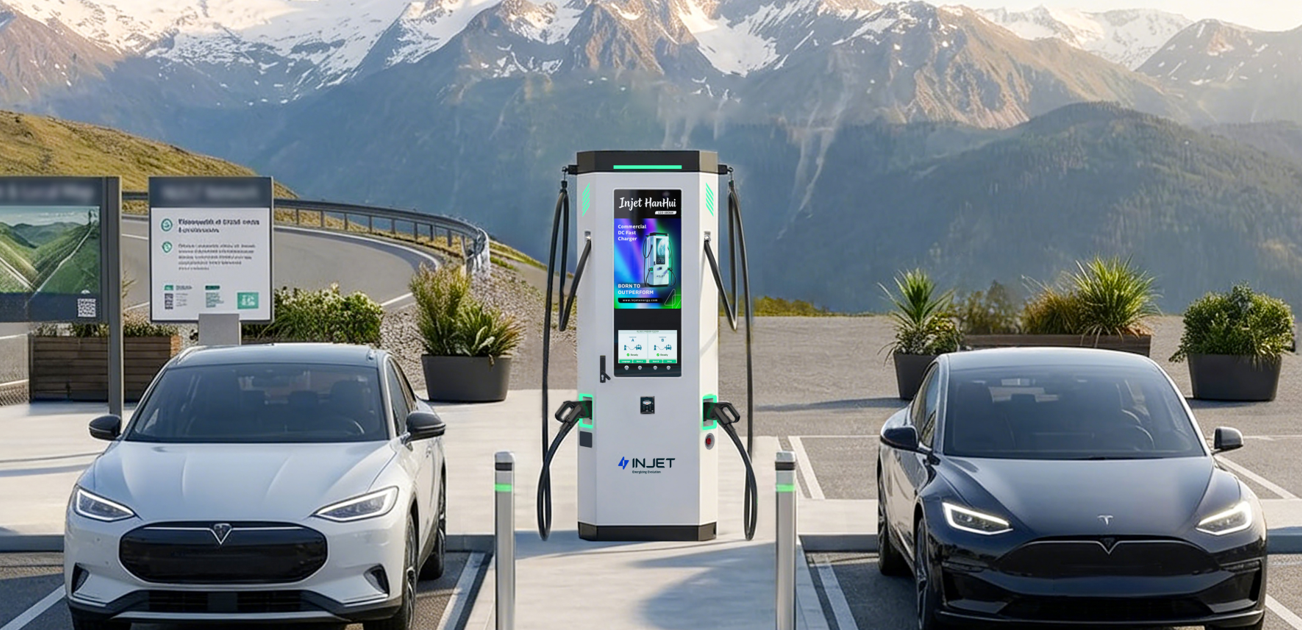
For global manufacturers like Injet New Energy building charging hardware for multiple markets, supporting multi-standard or modular connector configurations is increasingly important. Smart charging stations that accommodate NACS, CCS1/2, within a single unit — rather than requiring dedicated dispensers — reduce installation complexity and future-proof sites against standard shifts.
What matters most for site operators and EV owners alike is not picking the “winning” plug, but understanding compatibility well enough to make informed decisions today.
Conclusion
The EV charging connector landscape is more complex than it appears on the surface, but it follows a clear logic once you understand the AC/DC split, the role of regional standards, and the shift toward NACS in North America. Whether you’re an EV owner deciding on a home wallbox, a fleet manager planning depot charging, or a site host designing a public charging facility, connector compatibility is the technical detail that makes or breaks the experience.
As the industry standardizes, the most important move is staying current — because today’s dominant format wasn’t yesterday’s, and tomorrow’s may look different still.