


When EV drivers talk about charging, “speed” is always the headline. But the real technical parameter behind fast charging is far more than just a power rating. Voltage is what ultimately defines the upper limit of charging efficiency, influences long-term battery health, and even shapes future technology pathways.
This article breaks down the physics behind voltage—and shows how it impacts every charging session you experience.
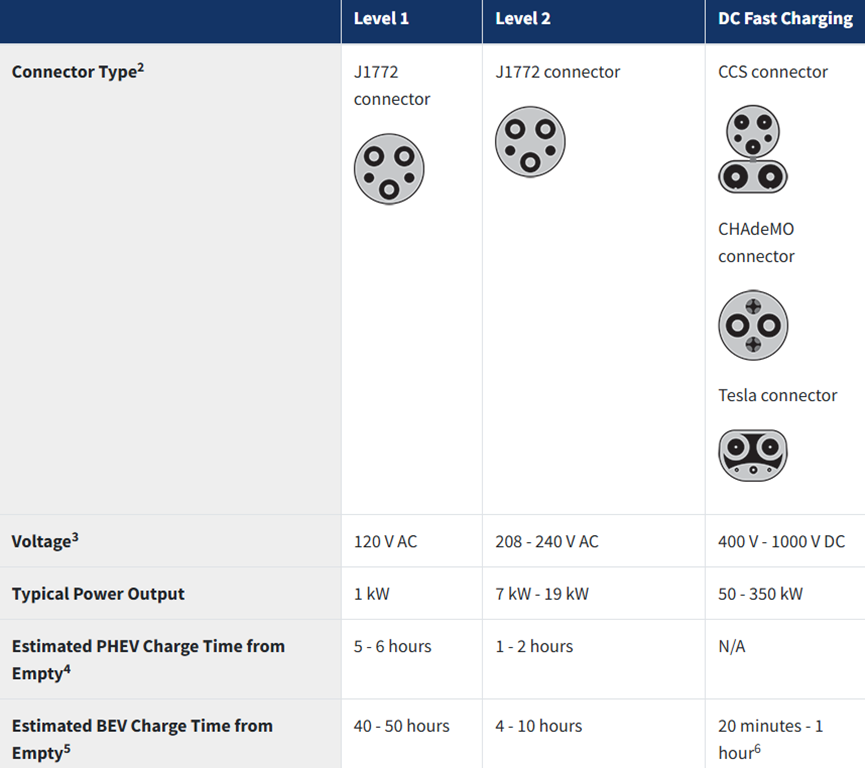
(Image Source: U.S. Department of Transportation)
1. The Efficiency Leap — Why 800V Became a Technological Watershed
According to basic physics, power (P) = voltage (V) × current (A).
To increase charging power, you can either raise the voltage or push more current. But higher current brings major drawbacks: thicker cables, more heat, and higher energy losses. This makes voltage elevation the more effective upgrade path.
This is why 800V high-voltage platforms are widely considered a watershed moment for EV technology.
Take the Porsche Taycan—one of the first mass-produced 800V EVs. Its system supports charging power up to 320 kW. More importantly, at the same energy transfer, current can be reduced by half, significantly lowering thermal losses and improving overall charging efficiency.
The result is a visibly better user experience: the Taycan can charge from 10% to 80% in as little as 18 minutes on an 800V ultra-fast charger.
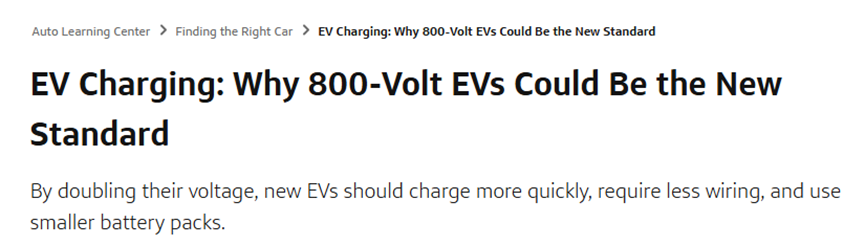
(Image Source: Capital One Auto Navigator)
2. Compatibility Trade-offs — The Wisdom and Cost of “Downward Compatibility”
The challenge today is that 800V-capable EVs can’t always find matching high-voltage chargers.
A good example is the Hyundai IONIQ 5. While the vehicle supports 800V charging, most Tesla Supercharger V3 stations deliver around 500V.
To adapt, the vehicle must activate its internal DC/DC converter and “step down” the voltage to 400V—limiting peak charging power to about 135 kW, far below its maximum capability of 257 kW.
This downward compatibility is smart engineering—but it comes with performance loss.
And this limitation is accelerating the industry’s shift toward higher-voltage public charging infrastructure.
3. Safety Boundaries — The Absolute Limits of Voltage Scaling
As voltage levels climb, safety becomes the non-negotiable red line.
High voltage imposes strict requirements on insulation, thermal management, and real-time monitoring.
IEC 61851 defines clear limits:
- 1)Up to 1000V AC
- 2)Up to 1500V DC
In parallel, the latest CCTA validation framework now covers 150V–1000V, and is laying the foundation for future megawatt-class charging systems.
These standards collectively form the “guardrails” ensuring faster charging never compromises safety.
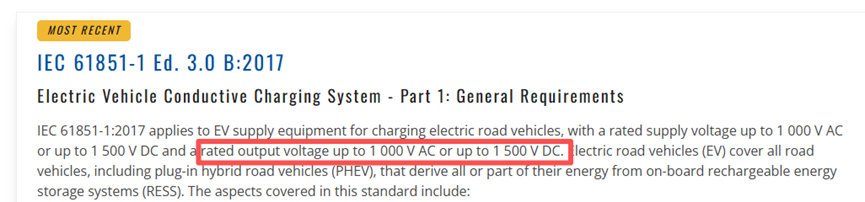
(Image Source: ANSI WEBSTORE)
The Future — Beyond Higher Voltage, Toward Smarter Voltage
The next stage of competition isn’t just about raising voltage platforms from 400V to 800V and beyond.
The real value lies in intelligent voltage management:
- 1)Precision BMS control
Fine-tuning voltage ramp rates during the final charging phase to balance speed and battery longevity. - 2)Charger-vehicle coordination
Real-time communication between the charger and the vehicle’s BMS to shape the optimal charging curve. - 3)All-climate adaptability
Advanced thermal systems ensure fast charging remains safe and efficient in extreme cold or heat.
Conclusion
Voltage is far more than a cold technical parameter. It links charging efficiency, charger compatibility, system safety, and battery health.
For EV owners, understanding your vehicle’s maximum charging voltage helps you plan long trips and choose chargers that unlock its full performance.
For the industry, voltage evolution represents a comprehensive race in materials science, electrical engineering, and intelligent control.
As charging technology evolves, chargers themselves must support wider voltage ranges, higher power density, and smarter control algorithms.
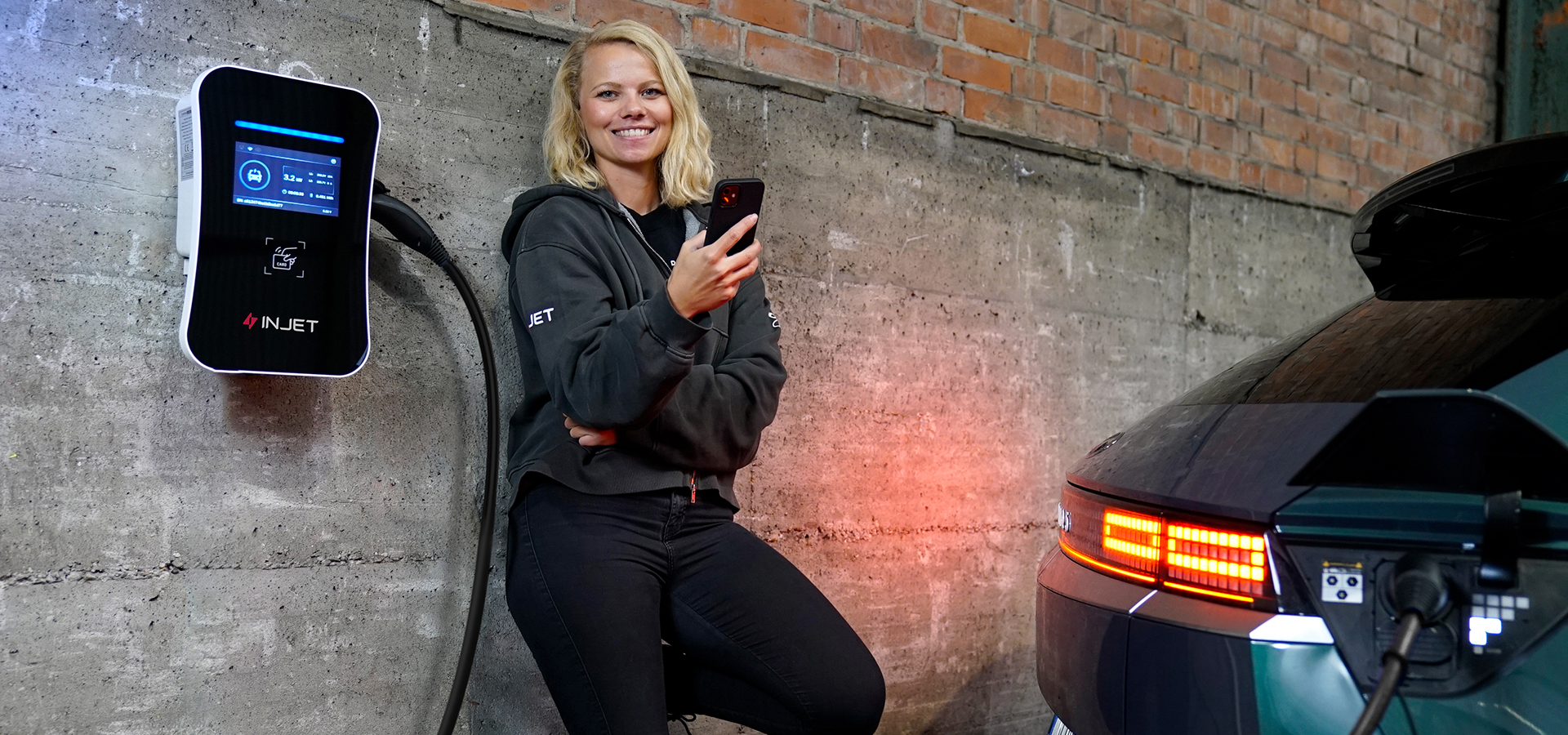
This is exactly what Injet New Energy is building—chargers that signal one simple message:
No matter how EV technology evolves, we deliver fast, safe, and reliable power for every vehicle.