


The cost of EV charger installation is not a fixed figure and varies significantly across countries and use cases. According to the International Energy Agency (IEA)’s 2026 report, grid upgrades and safety compliance account for 40% to 60% of the total installation cost for commercial DC fast charging stations in the EU. Meanwhile, subsidy policies in countries like France can cover up to 30% of construction expenses, which is a key factor driving the substantial price differences between regions
EV charger installation cost is driven primarily by power distribution and construction work.
This article explains the true cost structure behind EV charger deployment and introduces a compact DC solution that can significantly reduce infrastructure complexity — the Injet Hub Wallbox DC EV charger.
What Makes Up the EV Charger Installation Cost?
A complete EV charging installation typically includes:
1.Charging equipment cost
2.Electrical power distribution upgrades
3.Construction and civil work
4.Operation and maintenance
Among these, power distribution upgrades are usually the most expensive and time-consuming part of the project.
Why Power Distribution Often Determines Total Project Cost
Conventional DC fast chargers commonly operate at 60 kW, 120 kW or higher. Such power levels often require:
1.new transformer capacity
2.additional switchgear
3.heavy-grade cabling
4.utility grid approval procedures
These electrical upgrades frequently represent the largest portion of total EV charger installation cost and can delay project timelines.
As a result, many commercial parking operators and property owners seek lower-power DC charging solutions that can integrate into existing electrical systems more easily.
The Rise of Compact DC EV Charging Solutions
A new category of 30–40 kW DC EV charger is gaining popularity in commercial parking facilities, office buildings and retail locations.
At this power level, in many site conditions, a DC EV charger can often be integrated into existing building electrical capacity without major transformer expansion, depending on local regulations and available grid capacity. This significantly reduces infrastructure complexity while still delivering true DC fast charging performance.
Injet Hub Wallbox DC EV Charger — Designed for Efficient Deployment
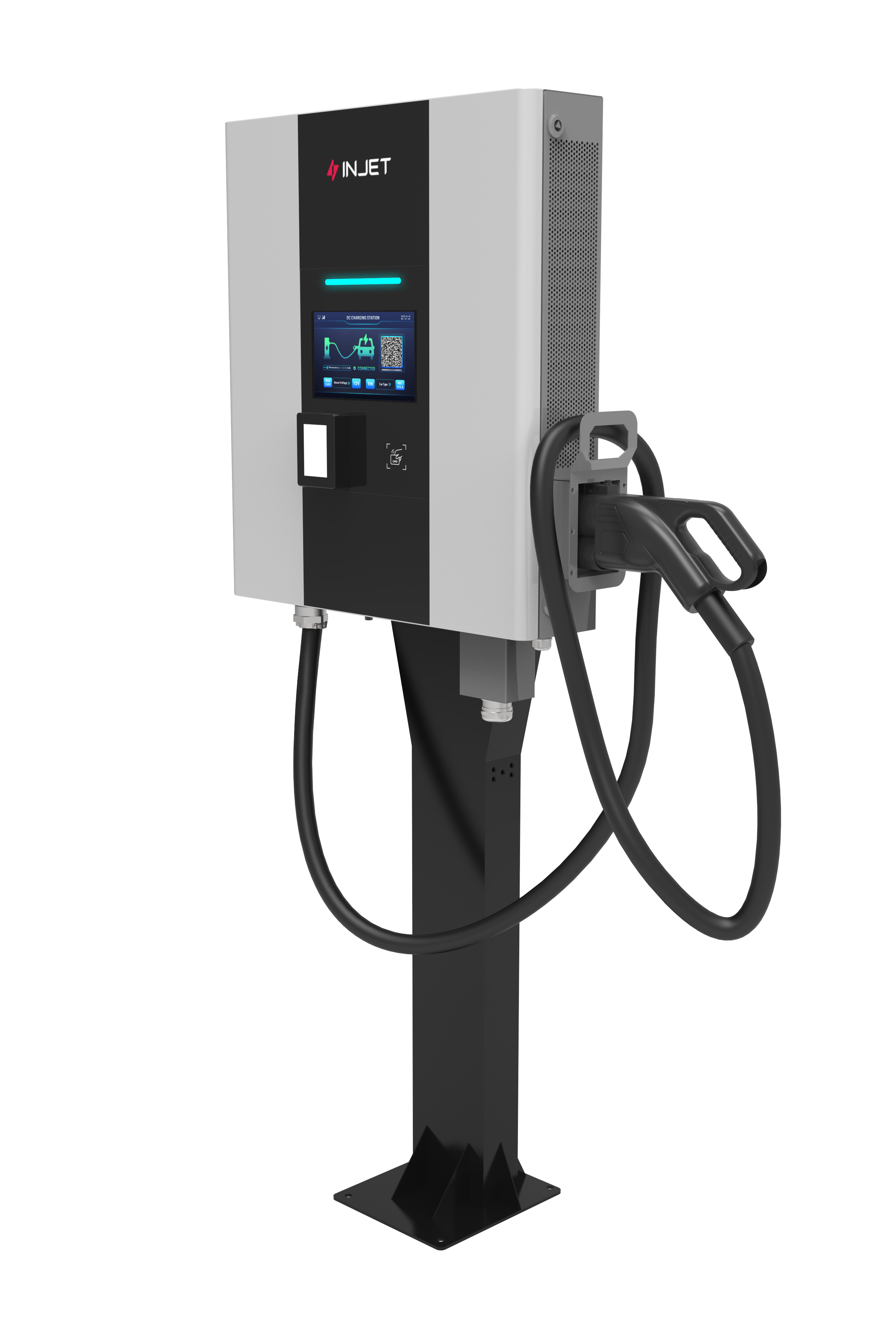
The Injet Hub Wallbox DC EV charger is purpose-built for space-limited and cost-sensitive installations.
Instead of a bulky floor-standing cabinet, it provides a compact wall-mounted DC charging solution that simplifies both power distribution planning and on-site construction.
Key Specifications:
1.Output power: 30–40 kW
2.Supports CCS charging (CCS2 fast charging)
3.Ultra-slim body: 750 × 600 × 150 mm
4.Lightweight: only 60 kg
5.Optional built-in Payter payment module
6.Dedicated mounting base included
7.Designed for one-person installation
It is among the slimmest DC EV chargers in its power class, making it ideal for parking garages, shopping centers, office buildings and other space-constrained environments.
How Wall-Mounted Design Reduces Construction Work
Traditional DC fast chargers typically require ground foundations, concrete bases, heavy lifting equipment and protective bollards. These civil works increase project time and site disruption.
With its wall-mounted structure and dedicated mounting base, the Injet Hub Wallbox DC EV charger eliminates large foundation work, reduces installation labor, saves parking space and enables rapid deployment with minimal on-site disruption.
This design approach simplifies project execution and allows faster rollout of EV charging infrastructure.
Conclusion — Smarter EV Charger Deployment for Modern Sites
Installing an EV charger does not always require heavy grid upgrades and complex construction.
By choosing a compact DC EV charger with wall-mounted architecture and intelligent power integration, site owners can deploy fast charging more efficiently, with lower infrastructure complexity and faster project timelines.
For operators seeking CCS charging capability, true DC EV charger performance, wall-mounted installation and portable electric car charger flexibility, the Injet Hub Wallbox DC EV charger offers a practical and future-ready solution.
Its not only about hardware, we can also provide landlord with software to operating the public point,you can find more information at our other article:EV Charging Software Solution: How Injet Eco Powers Smart Charging
Contact us now to find out more!