


IP54 in EV Charging Equipment: What It Really Means for Injet EV Chargers
When users search for IP54, they are often looking for reassurance — whether a device can withstand dust, moisture, and real-world operating conditions.
In electric vehicle charging, however, IP ratings are not standalone specifications. They are part of a much larger system design that determines safety, reliability, and long-term performance.
This article explains how IP54 should be understood in EV charging applications, and why the way a manufacturer engineers and validates protection matters more than the rating label itself. Using Injet EV chargers as an example, we explore how ingress protection fits into real charger design and testing.
What IP54 Means Under IEC Standards
IP ratings are defined by the international standard IEC 60529, which classifies the degree of protection provided by enclosures against solid objects and liquids.
The first digit 5 indicates protection against dust that could interfere with normal operation
The second digit 4 indicates protection against water splashing from any direction
Official standard reference:
https://www.iec.ch/ip-ratings
In EV charging equipment, IP54 typically applies to indoor or semi-outdoor installations, such as garages, covered parking areas, or locations with partial environmental exposure.
Why IP Ratings Alone Do Not Define EV Charger Reliability
In EV charging, it is common to see chargers labeled with IP54 or even higher ratings. However, IP rating alone does not guarantee real-world reliability.
This is because IP testing evaluates enclosure protection under defined laboratory conditions — not continuous operation, thermal stress, or long-term aging.
Industry guidance consistently emphasizes that charging equipment reliability depends on system-level engineering, not enclosure sealing alone.
Reference example (general EV charging installation guidance):
https://www.evcharginginstallers.co.uk/blog/ip-ratings-ev-chargers
For EV chargers, ingress protection must be considered together with:
1)Overheat protection design
2)Component layout and spacing
3)Cable entry and sealing design
IP54 vs IP65 — Application Matters More Than Numbers
IP54 = Dust-protected, splash-resistant, Indoor or covered charging environments
IP65 = Dust-tight, resistant to water jets, Fully outdoor, exposed installations
Higher ratings such as IP65 are essential for harsh outdoor conditions, but they also require more complex thermal and enclosure design.
Injet’s ev chargers are all IP65 level, make it suitable for every situation.
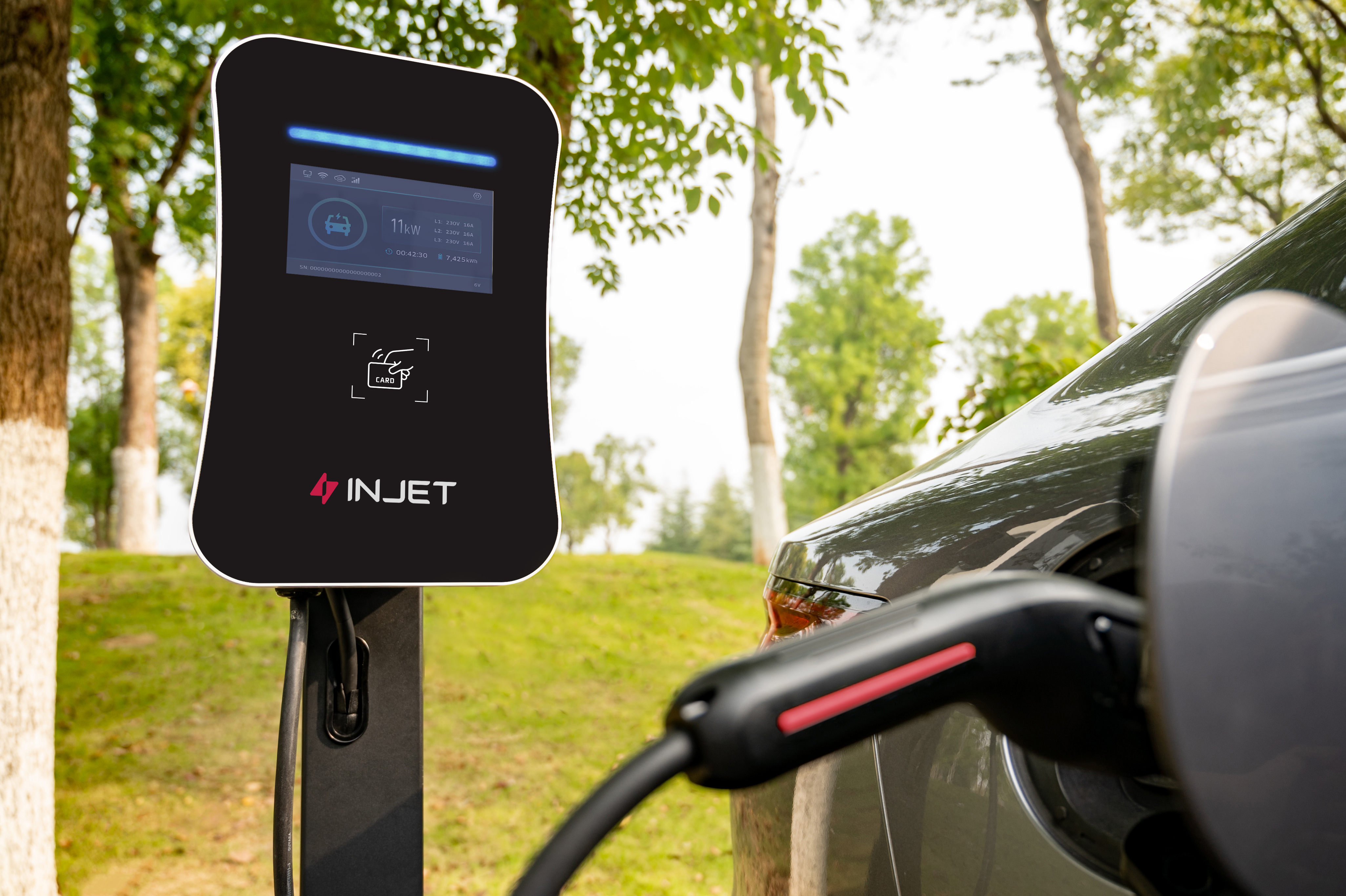
injet Swift2.0 ac ev charger
How Injet Engineers Ingress Protection in EV Chargers
Injet is not an assembly-only brand.
As a publicly listed company with over 3,000 employees, Injet designs and manufactures its EV charging station with in-house engineering control, including self-developed PCB design and production.
This vertical integration allows ingress protection to be addressed at both component and system level, rather than treated as an enclosure-only requirement.
Multi-Stage Testing Beyond Standard IP Checks
Ingress protection claims must be verified through testing — not assumed.
Injet EV chargers undergo multi-stage validation, including:
1)Component-level aging tests
2)Subassembly testing
3)Full system operational testing
4)Environmental simulation in controlled laboratory conditions
Each test cycle lasts over 8 hours, and products are tested repeatedly across multiple stages — from individual parts to fully assembled chargers. Dedicated clean-room and environmental testing facilities are used to verify resistance to moisture, dust, and operational stress.

injet’s dust-free workshop
This approach goes beyond basic compliance and reflects real charging lifecycle conditions rather than short-duration certification tests.
Check more about injet’s ev charger manufacturing factory here:
https://www.injetenergy.com/manufacturing-capability/
IP54 as Part of a Complete EV Charger Design
In professional EV charging projects, IP54 should be viewed as one element of a complete design strategy, not as a purchasing shortcut.
A charger labeled IP54/IP65 can perform reliably only if it is supported by:
1)Electrical safety architecture
2)Robust manufacturing processes
3)Long-term validation testing
This is where the difference between Injet and parameter-focused suppliers becomes clear.
From IP Ratings to Manufacturing Expertise
If your research started with IP54, your real concern was likely reliability.
In EV charging, reliability does not come from a rating alone — it comes from how a manufacturer engineers, tests, and validates that rating in real charging conditions.
Injet EV chargers are designed with this principle in mind, combining ingress protection with system-level engineering, in-house manufacturing, and repeated validation testing.
Conclusion
IP54 is a useful and widely applied protection level in EV charging equipment — when used correctly.
But understanding how that rating is implemented matters more than the number itself.
By evaluating IP protection through the lens of engineering design and manufacturing capability, buyers can make more informed decisions and avoid mistaking labels for long-term reliability.
Learn more about Injet EV chargers and how they are engineered for real-world charging environments:
https://www.injetenergy.com