


In Europe, EV adoption is crossing critical thresholds at an unprecedented pace. Driven by the Alternative Fuels Infrastructure Regulation (AFIR) and the industry-wide transition to 800V high-voltage architectures—championed by brands like Porsche, Hyundai, and Audi—the focus of public charging station deployment has shifted from mere "existence" to "performance."
However, in the race for "peak power," the industry has fallen into a dangerous logical trap: Does higher total nameplate power inherently equate to higher station efficiency? The reality often tells a different story. Many Charge Point Operators (CPOs) have invested heavily in megawatt-scale deployments, only to find that their financial payback periods are far longer than expected, hampered by low utilization rates and exorbitant grid upgrade costs. The Injet HanYuan Distributed Charging System was developed specifically to shatter this "more is better" illusion and redefine the economics of charging infrastructure.
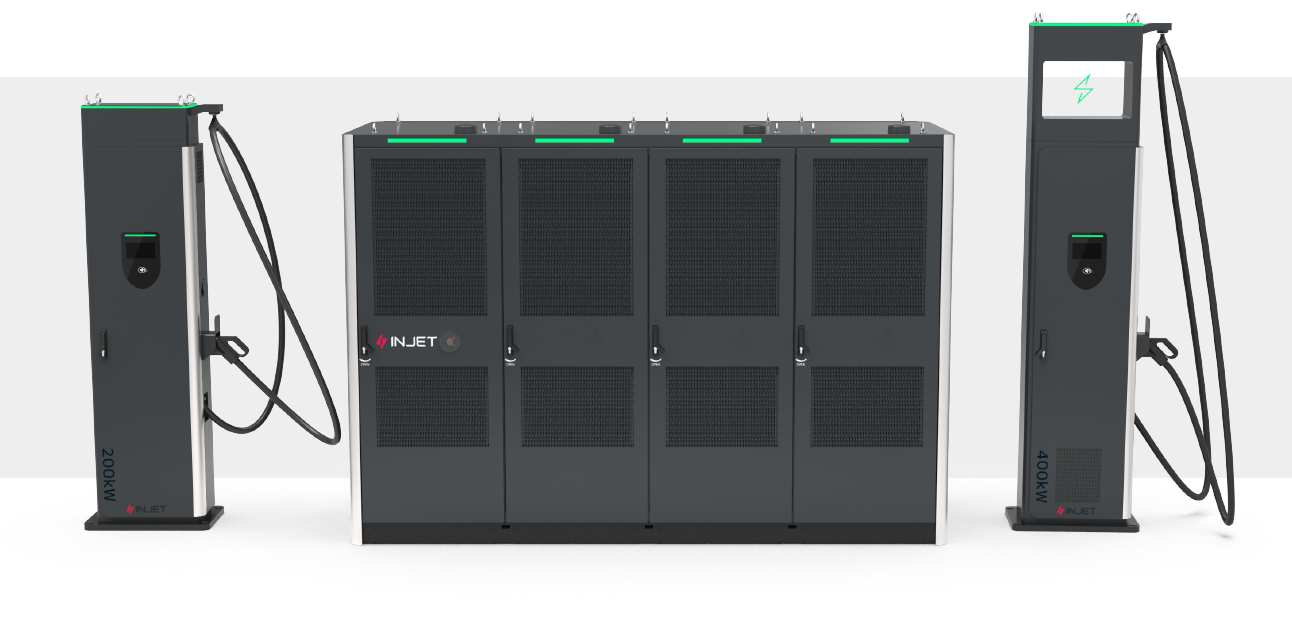
The Status Quo: The Megawatt "Waste"
The current EV market is highly heterogeneous. A typical public charging hub must simultaneously serve a premium sedan requiring 350kW, a compact commuter limited to 80kW, and a logistics vehicle with a flat charging curve.
Legacy "Integrated Chargers" struggle in this scenario. These systems typically employ fixed power allocation. For example, in a 200kW dual-gun charger, if a vehicle requiring only 80kW is plugged in, the remaining 120kW is effectively "locked" and stranded—unable to flow to a nearby vehicle in desperate need of power. This "siloed" architecture results in massive resource idling. For operators, you are paying for 200kW of hardware and requesting 200kVA of transformer capacity, yet your cash flow is limited by the vehicle’s specific intake capacity.
Simulation: Breaking the "Bigger is Better" Myth
To quantify the value of "Power Utilization," we conducted a simulation based on real-world operational scenarios.
The Setup:
-
Infrastructure: 24 charging bays.
-
Traffic Flow: 200 vehicles with varying battery capacities and charging protocols.
-
Total Energy Demand: 15,000 kWh.
-
Competitor A (Traditional Integrated Chargers): 12 units of 200kW dual-gun chargers.
-
Total Nameplate Power: 2400kW
-
-
Competitor B (Injet HanYuan): One Injet HanYuan Distributed Charging System connecting 24 satellite terminals.
-
Total Nameplate Power: 1920kW
-
The Verdict: Precision Allocation > Total Power
In the traditional 2400kW system, power cannot be routed across chargers. The average utilization rate is below 80%, with vast amounts of capacity wasted while waiting for vehicle BMS handshakes. The total time to clear the queue was 7.85 hours.
Conversely, the Injet HanYuan system, with a total capacity of only 1920kW, achieved an average utilization rate of ~96% due to its dynamic sharing, clearing the queue in roughly 8.0 hours.
Key Conclusion: The Injet HanYuan system achieved nearly identical throughput using 20% (480kW) less installed capacity than the traditional setup. This reduction is not just a saving in CAPEX; it translates into lower transformer capacity requirements, simplified grid interconnection, and reduced fixed monthly electricity costs.
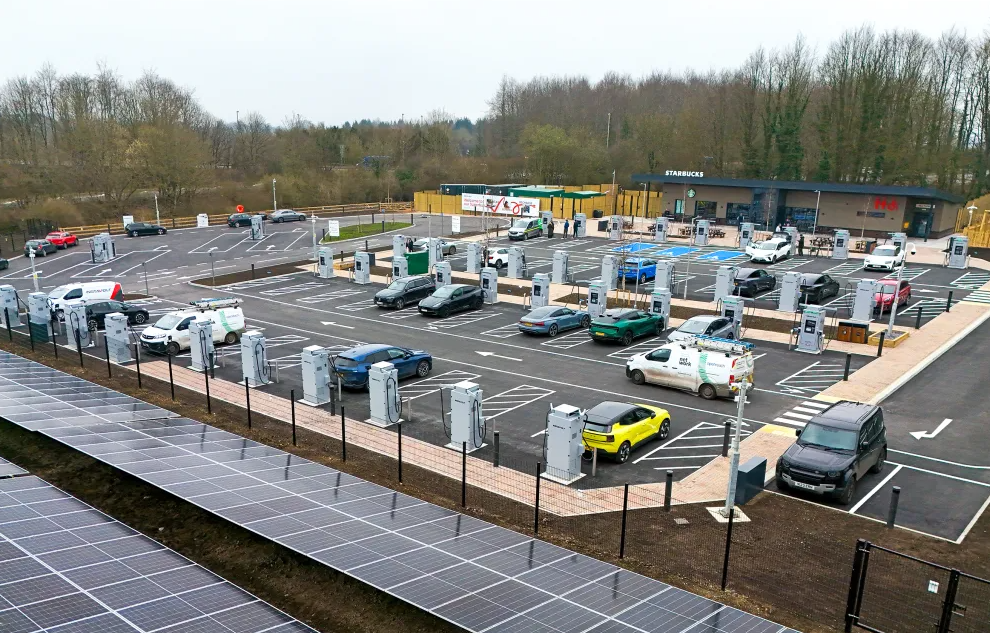
(image source: THE SUN)
The Injet Solution: Making Every Kilowatt "Fluid"
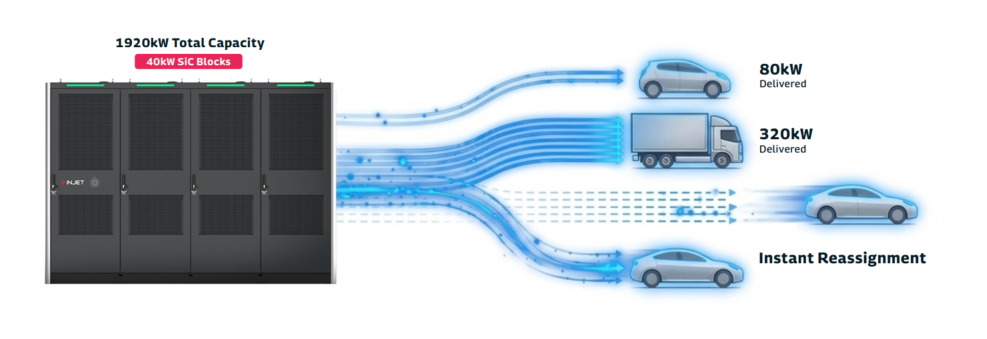
How does Injet HanYuan achieve more with less? The answer lies in its revolutionary "Power Pool" architecture, featuring modular, flexible allocation. We have deconstructed total power into a matrix of 40kW SiC (Silicon Carbide) modules.
-
Full-Matrix Dynamic Flow: In the Injet HanYuan system, power is no longer physically isolated. Using millisecond-level scheduling algorithms, the system intelligently detects the BMS demand of every connected vehicle. As one vehicle enters the tapering stage at 80% SoC, the freed-up 40kW modules are instantly re-routed to a vehicle entering its high-demand peak.
-
SiC-Powered Efficiency: Our Silicon Carbide modules provide a smaller footprint and boost system efficiency by 1.9%. Over a ten-year operational lifecycle, this reduction in conversion loss converts directly into bottom-line profitability.
Conclusion: Evolving Toward "On-Demand" Green Infrastructure
As electrification enters a more mature phase, the competition in charging infrastructure is no longer about stacking parameters; it is a battle of efficiency-to-investment ratios (ROI).
The Injet HanYuan design philosophy is one of evolution, not just addition. It grants infrastructure the "elasticity" of cloud computing—dynamic, on-demand, and scalable. By liberating power capacity from fixed physical silos, Injet HanYuan not only provides an "ultra-fast, plug-and-charge" experience for drivers but also empowers operators to build a more resilient, future-proof microgrid node that natively supports solar PV and energy storage integration.
In our journey toward net-zero, we need more power, but more importantly, we need the smarter, more fluid energy management provided by Injet HanYuan.
Ready to optimize your charging site? [Click here to download the Injet HanYuan Product Brochure]
