

The real challenge of corporate electrification is not the vehicle itself
In France, the electrification of corporate fleets has entered a new phase.
From the regulatory framework to vehicle availability, and from charging infrastructure to market readiness, external conditions are gradually falling into place. Yet in practice, many companies are discovering that what truly affects the efficiency and cost structure of their transition is not the electric vehicle itself, but the set of organizational and deployment decisions made around it.
Should vehicles be owned as long-term assets?
Is leasing more suitable in exchange for cost predictability?
Is it preferable to outsource vehicles, charging, and operations as a whole?
Is there room to retrofit existing fleets?
Or do some mobility needs not require long-term vehicle allocation at all?
There is no single correct answer to these questions. But together, they determine one fundamental point:
Corporate electrification is a management decision, not a product choice.

(Image Source: coast)
Five corporate EV deployment models: understanding the real differences through comparison
In practice, corporate EV deployment models can broadly be grouped into five categories:
purchase, long-term leasing, FaaS (subscription-based services), shared and alternative solutions, and retrofit.
These models are not different solutions to the same problem. Rather, each corresponds to distinct usage intensities, financial structures, and levels of organizational maturity. Comparing them within a single framework is often more helpful for decision-making than evaluating them in isolation.
Comparison of the five corporate EV deployment models
|
|
Advantages |
Limitations |
|
Purchase (Achat) |
l Full ownership and control of vehicle assets l No mileage or contractual usage restrictions l Vehicle configuration and usage rules can be defined internally l Total cost of ownership (TCO) can be controlled when the usage cycle is clearly defined |
l High upfront investment (CAPEX) l Depreciation and residual value risks borne by the company l Maintenance, insurance, and charging must be managed internally l Requires strong internal fleet management capabilities |
|
Long-term leasing (LLD / LOA) |
l Clear cost structure and predictable budgeting (OPEX) l Regular vehicle renewal, reducing technology risk l Maintenance and insurance are often included l Well suited to highly standardized fleets |
l Total long-term cost is generally higher than ownership l Mileage and usage constraints apply l Limited flexibility and customization l Adjustments can be costly when operational needs change |
|
FaaS / Subscription-based services |
l Integration of vehicles, charging, and operations l Centralized management interfaces, reducing internal workload l Fast deployment, suitable for pilot projects or transition phases l Lower internal resource requirements |
l High dependency on the service provider l Long-term costs are usually higher l Flexibility depends heavily on contract design l Less suitable for fleets with highly mature management systems |
|
Retrofit |
l Extends the service life of existing vehicles l Feasible in specific closed or specialized use cases l Can avoid duplicate investment when vehicles are already equipped with dedicated or customized onboard equipment that is difficult or impractical to transfer to new vehicles |
l High costs and unstable economic viability l Significant technical and regulatory constraints l Uncertain residual value and long-term reliability l Limited real-world applicability |
|
Shared and alternative solutions |
l High flexibility with no long-term assets or contractual commitments l Helps control or reduce fleet size l Aligned with low-carbon mobility and ESG objectives l Suitable for low-frequency or non-continuous use cases |
l Difficult to cover high-frequency or rigid mobility needs l Requires strong employee compliance and internal rules l Availability depends on platforms or organizational capability l Generally serves only as a complementary solution |

(Image Source: Dick Lovett)
Once the deployment path is defined, how charging avoids becoming a new constraint
Across all deployment models, the methods of vehicle acquisition differ. Yet one condition remains constant:
Charging capacity is a prerequisite for all paths.
If charging planning lags behind, even a sound vehicle strategy can encounter serious execution issues.
Charging is fundamentally a question of “fit”
Different deployment models do not differ in whether charging is needed, but in the type of constraints they impose:
1)Owned or long-term leased fleets prioritize stability, scalability, and long-term operations
2)Pilot or hybrid models emphasize deployment speed and complexity control
3)Multi-scenario use cases (corporate sites, employee homes, semi-public locations) require compatibility and unified management
This means companies are not simply choosing “which charging equipment to buy,” but rather how to build a charging system that can evolve alongside changes in fleet structure.
In the context of corporate fleets, the value of a charging solution provider does not lie in deciding vehicle deployment strategies on behalf of the company, but in:
1)Understanding the constraints behind different deployment models
2)Designing solutions with long-term operations and scalability in mind
3)Avoiding the transfer of additional complexity to internal teams
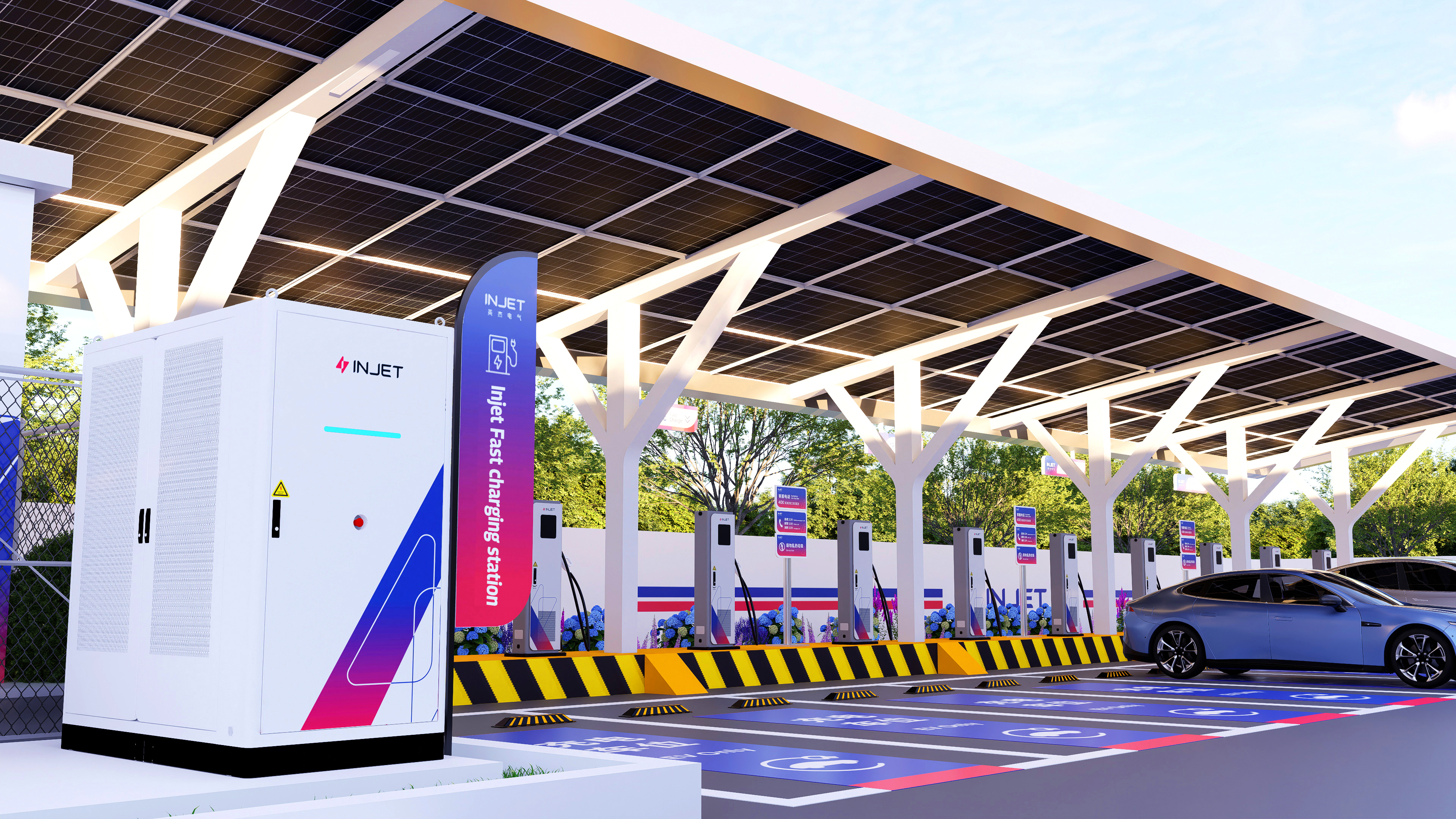
From this perspective, INJET positions itself closer to a provider of foundational capabilities.
Its role is not to steer companies toward a specific path, but to ensure that—regardless of the deployment mix ultimately chosen—charging does not become a structural bottleneck in the electrification process.
Conclusion
From vehicle acquisition to charging infrastructure, corporate fleet electrification has never been merely a technical issue.
It tests whether companies are willing to adopt a long-term view of mobility needs, and whether they are capable of continuously adjusting strategies under uncertainty.
The optimal solution is not a single model, but the ability to make appropriate choices at each stage—while preserving flexibility for the next one. This, perhaps, is the true challenge of corporate electrification.