



Let our experts help you pick suitable chargers for your EVs!
As electric vehicles (EVs) continue to grow in popularity, the technology behind charging them has become increasingly important. Two critical factors influencing EV charging efficiency are the input voltage and charging current. These elements play a significant role in determining how fast and effectively a vehicle can charge.
What is the Input Voltage of an EV Charger?
The input voltage of an EV charger refers to the voltage supplied to the charging station by an external power source, such as the electrical grid, a vehicle alternator, or even renewable energy sources like solar panels. This input voltage influences the charger’s output voltage, which is supplied to the EV’s battery during charging.
What is the Output Voltage of an EV Charger?
One of the most common questions is whether the output voltage differs from the input.
1)AC Chargers: For AC charging stations (like Injet’s Swift), the output voltage is typically identical to the input voltage. The charger acts as a smart gateway, delivering the grid's AC power directly to the vehicle's onboard charger.
2)DC Chargers: For DC Fast Chargers (Injet Ampax/Injet Ampax Pro), the station performs an internal conversion. The output voltage is dynamic, ranging from 200V to 1000V, depending on the real-time requirements of the electric vehicle's battery management system (BMS).
Choosing a charger with a wide output voltage range ensures compatibility with both older 400V battery architectures and the latest 800V high-speed charging EVs.
EV chargers are categorized into three levels, each operating at different input voltages:
1. Level 1 Chargers: These are basic chargers that use a standard 120-volt AC outlet. These are the slowest chargers and are typically used at home.
2. Level 2 Chargers: A significant upgrade from Level 1 chargers, Level 2 chargers utilize 208/240 volts in the United States, where 240 volts are typically used for residential settings (Injet Blazer Level2 Home Charger), and 208 volts for commercial applications (Injet Vision EV Charger For Commercial Use). In Europe, they operate at 230 volts single-phase or 400 volts three-phase (Injet Swift EU Series). These chargers are widely used for homes, workplaces, and public charging stations.
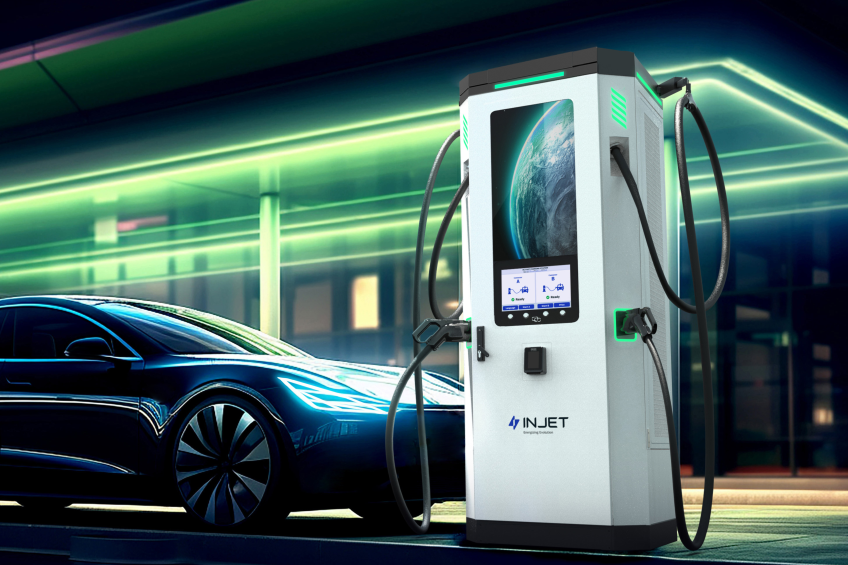
3. Direct-Current Fast Chargers (DCFC): Also known as Level 3 chargers, these systems use a three-phase 480-volt AC circuit but deliver DC directly to the vehicle’s battery, allowing for rapid charging. In many cases, DCFCs can charge an EV’s battery to 80% in just 30 minutes, making them a popular choice for highway rest stops and commercial applications.(Injet Ampax Level 3 Fast Charging Station)
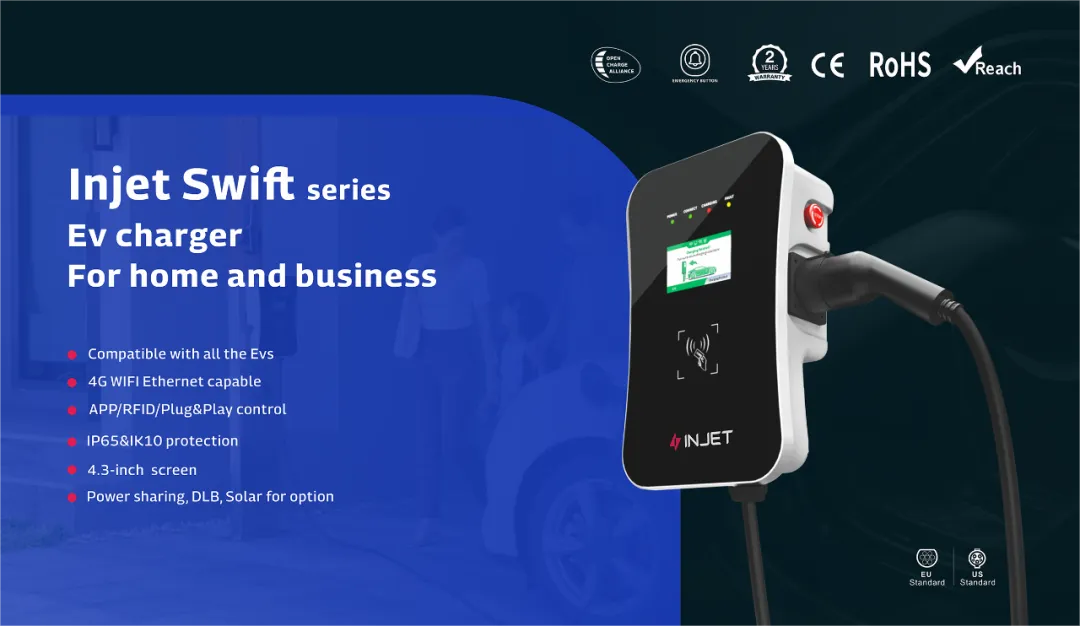 (Injet Swift Level 2 AC Charger)
What is the Current of an EV Charger?
The current of an EV charger, measured in amperes (amps), is a major factor in determining how quickly the battery charges. A higher current enables more energy to be transferred in a shorter time, increasing the speed at which the EV charges.
1. Current of Level 2 EV Chargers
These chargers come in various models delivering between 15 and 80 amps. Most newer models operate at 40 to 48 amps, which is sufficient to fully charge almost any EV overnight. Commercial chargers, which typically operate at 80 amps, provide faster charging and are ideal for high-traffic areas.
2. Current of Level 3 EV Charging Station (Direct-Current Fast Chargers (DCFC))
These stations often operate with current values between 100 and 400 amps, enabling them to charge EVs in a much shorter time.
Quick Reference: EV Charging Power Specifications
To help you plan your charging infrastructure, here is a breakdown of common voltage and current configurations used globally:

How Do Voltage and Current Affect EV Charging?
The total power delivered to an EV during charging is measured in kilowatts (kW). Power is the product of voltage (V) and current (A). Therefore, both the input voltage and current are critical in determining how fast an EV can be charged. For example, a charger operating at 240 volts and delivering 40 amps would supply 9.6 kW of power to the vehicle.
However, both the charger and the EV have their own voltage and current limitations, meaning that charging speeds are constrained by the maximum capacity of either the charger or the vehicle. If a vehicle can only accept a certain amount of power, using a more powerful charger will not necessarily speed up the charging process.
How to choose a EV charger with the right amperage for your electric vehicle?
1. The vehicle model and its battery capacity
· Plug-in Hybrid Electric Vehicles (PHEVs) typically have a maximum charging rate of 32 amps. As a result, even if you use a higher-powered charger, it will not speed up the charging time.
· For fully electric vehicles, a 32-amp charger is generally enough if the vehicle’s maximum accepted power is 7.7 kW or less. However, for EVs that can accept more power, using a 40-amp or 48-amp charger will result in faster charging times.
It’s important to check the specifications of your EV to ensure that the charger’s amperage matches the vehicle’s maximum charging capacity. A charger delivering more current than the vehicle can handle will not improve charging speed.
2. Needed for home or commercial use
Most home chargers are level2 AC chargers. These chargers come in various models delivering between 15 and 80 amps. Most newer models operate at 40 to 48 amps, which is sufficient to fully charge almost any EV overnight. Level 2 Commercial chargers, which typically operate at 80 amps, provide faster charging and are ideal for high-traffic areas. And Level 3 DC charging stations often operate with current values between 100 and 400 amps, enabling them to charge EVs in a much shorter time.
3. Circuit Requirements for EV Charger Installation
When installing an EV charger, the capacity of your home or building’s electrical circuits is also an important consideration. For example, a 32-amp charger requires a 40-amp circuit, while a 40-amp charger needs a 50-amp circuit. A 50-amp charger will require a 70-amp circuit. Ensuring the circuit can handle the additional load is vital for safety and functionality.
In some cases, especially when upgrading to higher-amperage chargers, you may need to have an electrician upgrade your electrical system, which could add to the overall installation cost.
Ready to learn more?
FAQ
A 22kW charger typically requires a 400V three-phase AC input with a 32A current per phase. This is the standard configuration for commercial and industrial sites in Europe and the UK to provide maximum AC charging speeds.
480V is usually reserved for industrial or commercial DC fast-charging sites. Most residential areas only provide 120V or 240V (North America) or 230V/400V (Europe). Before purchasing high-voltage equipment, always verify your local grid capacity.
EV chargers are sensitive to voltage fluctuations. Significant voltage drops can lead to reduced charging power or even safety shut-offs. Injet Energy chargers include built-in under-voltage and over-voltage protection to ensure safe operation even when grid stability varies.
Yes. Charging voltage is the electrical potential supplied by the charger (e.g., 240V AC or 400V DC), while battery voltage is the internal state of the EV's battery pack (typically 400V or 800V). The charger and the vehicle's BMS work together to match these levels safely.
According to the "80% rule" for continuous load, a 48A charger requires a 60A circuit breaker. This ensures that the electrical system can handle the high current and voltage over long charging sessions without overheating.
Feb-21-2026