


Why a 480 kW EV Charger Does Not Always Deliver 480 kW
Imagine a vehicle advertised with a peak charging power of 480 kW pulling into a station equipped with a 480 kW DC fast charger.
The two numbers match perfectly. Should the charging screen immediately show 480 kW?
Not necessarily.
Neither specification has to be wrong. The vehicle's figure describes what its battery system may accept under defined conditions. The charger's figure describes the highest output the equipment may provide within its own operating envelope. A real charging session happens only where those two envelopes overlap, and where the site can supply the required power.
This distinction is becoming more important as 400 V and 800 V vehicle platforms share the same charging network and charger nameplates move toward 480 kW and beyond.
Why XCharge's 200 to 1000 V C7 Announcement Matters
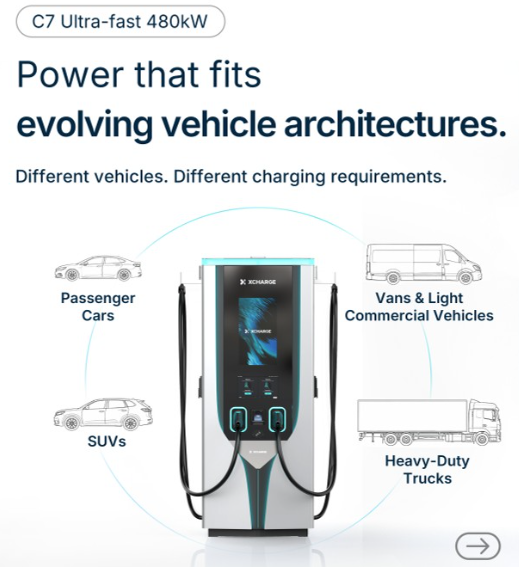
XCharge recently announced the C7, a DC fast charger rated at up to 480 kW with a stated output range of 200 to 1000 V. The company presented that wide voltage range as a way to serve today's EVs as well as emerging higher-voltage vehicle platforms.
The interesting part is not only the 480 kW headline. It is the reminder that maximum power and voltage coverage describe different capabilities.
A broad output-voltage range can allow a charger to work with a wider variety of battery packs. It does not, by itself, prove that the charger can deliver its maximum power at every voltage inside that range. To understand that, buyers also need the charger's current limit and its power-versus-voltage operating envelope.
The Basic Relationship Is Power Equals Voltage Times Current
On the DC output side, the basic relationship is:
Power (kW) is approximately equal to voltage (V) multiplied by current (A), divided by 1,000.
That simple equation explains why the same current limit produces different power at different battery voltages.
| Illustrative operating point | Calculation | DC power |
|---|---|---|
| 400 V at 500 A | 400 x 500 / 1,000 | 200 kW |
| 800 V at 500 A | 800 x 500 / 1,000 | 400 kW |
| 800 V at 600 A | 800 x 600 / 1,000 | 480 kW |
These are examples, not performance claims for the C7, Hanhui or any other specific charger.
They show why a 480 kW charger would require 600 A to deliver 480 kW at 800 V, but 1,200 A to deliver the same power at 400 V. If the charger, connector or cable cannot provide that current, the session will remain below 480 kW even though the charger carries a 480 kW nameplate.
400 V and 800 V Are Architecture Labels Not Fixed Session Voltages
An EV described as a 400 V or 800 V vehicle does not remain at exactly that voltage throughout every charging session.
The battery pack voltage changes with cell chemistry, state of charge, temperature and pack design. During DC charging, the vehicle's battery management system communicates what the battery can accept, while the charger adjusts its output within the limits of the equipment, cable and connection.
That means the relevant question is not simply whether the charger supports an 800 V vehicle. Buyers should ask how much power the charger can deliver across the voltage range in which their vehicles actually operate.
The Vehicle Can Become the Limiting Side
Even when a charger has sufficient voltage and current capability, the vehicle may request less power.
A battery that is cold, already at a high state of charge or outside its preferred temperature window will usually accept less current. The vehicle may reach its advertised peak only during a limited portion of an ideal charging session, then reduce its request as the battery fills.
This is why the peak number on a vehicle specification sheet should not be confused with its average charging power from arrival to departure. For a fleet, the time required to add the necessary energy is often more useful than a short-lived peak.
The Site Can Add Another Ceiling
A charger may be capable of 480 kW and a vehicle may be ready to accept it, yet the station can still allocate less.
The grid connection, transformer, site load, energy-management strategy and simultaneous demand from other charging bays all affect the power available to one connector. At a shared-power site, one vehicle's allocation can change as other vehicles arrive, leave or enter the tapering stage.
Real charging power is therefore limited by the most restrictive condition at that moment:
- The vehicle's requested voltage and current
- The charger's voltage, current and power envelope
- The cable and connector's permitted current
- The battery's temperature and state of charge
- The power allocated by the charging site
Wide Voltage Range Still Has Real Value
None of this makes a wide output range unimportant. It makes the range easier to interpret correctly.
A charging asset may remain in service longer than an individual vehicle model. During that period, a public station can encounter several generations of passenger cars, while a fleet depot may serve older vehicles and newly purchased high-voltage vehicles at the same time.
A sufficiently broad voltage range can reduce the risk that otherwise serviceable equipment becomes incompatible with a future vehicle platform. The commercial value, however, depends on both coverage and useful output inside that coverage.
A charger that can establish a session across a wide range but provides limited power to an important part of the fleet may be electrically compatible without being operationally suitable.
What CPOs and Fleets Should Check Beyond Maximum Power
Before comparing two high-power chargers, operators should ask for more than one number:
- What is the full DC output-voltage range? Confirm that it covers the real operating voltages of the target vehicles.
- What is the maximum output current? Current can become the main limit for lower-voltage vehicles.
- At what voltage does full rated power become available? A power-versus-voltage curve is more useful than a peak figure alone.
- Is the current rating continuous or time-limited? Cable cooling and thermal conditions can affect how long a high-current level is available.
- How is power shared between connectors? Check what happens when multiple vehicles charge at the same time.
- What can the site actually supply? Charger capability cannot compensate for an undersized grid connection or transformer without another energy source or an operating strategy.
- Which vehicle mix is expected over the asset's life? Public CPOs and fleets should test the selection against both today's vehicles and realistic future purchases.
Applying the Same Selection Logic to Injet Hanhui
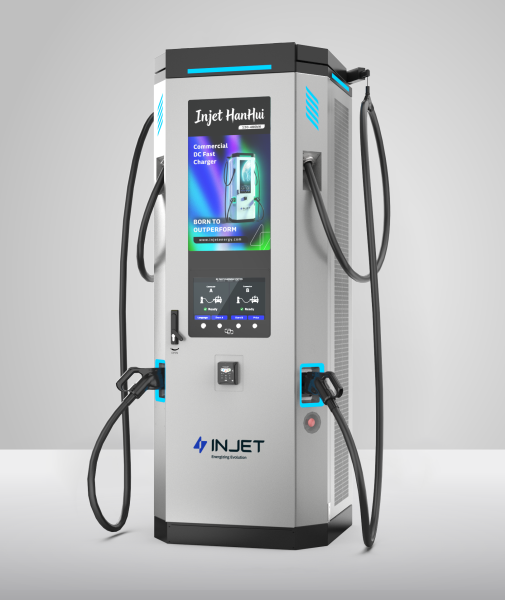
The same questions should be applied when evaluating Injet Hanhui for a high-power DC charging project.
The relevant Hanhui configuration should be selected from the project requirements: the expected vehicle mix, charging window, site capacity, connector arrangement and simultaneous demand.
This article does not assign an unverified voltage range, current limit or low-voltage power curve to Hanhui. Those values should be confirmed in the current project datasheet and matched against the vehicles the site is expected to serve.
That is not a minor engineering detail. It is the difference between buying the largest number on a brochure and selecting a charger that can turn the site's available electricity into useful charging sessions.
The Nameplate Is the Beginning of the Conversation
A 480 kW label describes a charger's upper boundary under specified conditions. It does not promise that every compatible vehicle will receive 480 kW, or that the site can provide that power to every bay at once.
Voltage range answers whether the charger can meet the battery's voltage. Current capability helps determine how much power is available at that voltage. The vehicle, battery condition and site then decide how much of that capability can be used at a particular moment.
For CPOs and fleets, the practical procurement question is therefore not only, “What is the maximum power?” It is, “Across the vehicles and operating conditions that matter to this site, how much usable power can this system deliver?”
Frequently Asked Questions
Why does a 480 kW charger sometimes deliver much less power?
The charging session is limited by the vehicle's request, the charger's voltage and current envelope, cable and connector limits, battery temperature and state of charge, and the power allocated by the site. The lowest active limit determines the result at that moment.
Does an 800 V EV always charge faster than a 400 V EV?
No. A higher-voltage architecture can reach high power with less current, but actual charging speed still depends on the vehicle's battery, charging curve, thermal conditions and the charger's capabilities.
Does a 200 to 1000 V range mean full power is available throughout that range?
Not automatically. Voltage range indicates where the charger can operate. Buyers also need the maximum current and the power-versus-voltage curve to determine the power available at each voltage.
Which specification is most useful for charger selection?
No single specification is sufficient. CPOs and fleets should evaluate voltage range, maximum current, the output envelope, simultaneous charging behavior and site power together with the expected vehicle mix.
Sources: XCharge C7 announcement; Injet Hanhui product page.