


If you’ve been reading EV charger spec sheets lately, you’ve probably run into a line that reads something like “ISO 15118-2 supported, ISO 15118-20 upgradable.” It’s a phrase that shows up more and more often, usually without much explanation of what it actually means or why it should factor into a purchasing decision. This guide breaks it down plainly — what ISO 15118 is, how the -2 and -20 generations differ, and why the distinction is becoming more relevant to buyers than it used to be.

What Is ISO 15118, Exactly?
ISO 15118 is the international standard that governs digital communication between an electric vehicle and a charging station — officially, the “Vehicle-to-Grid Communication Interface.” It’s easy to confuse with the basic signaling that tells a charger when to start and stop power flow (that’s handled separately, by the Control Pilot signal under IEC 61851). ISO 15118 sits on top of that basic layer and adds an actual digital conversation: the vehicle and charger can negotiate charging parameters, exchange identity and billing information, and — depending on the generation — coordinate far more sophisticated functions than simply turning power on and off.
In practical terms, ISO 15118 is what makes a charger “smart” in the communication sense, rather than just a switch. It’s the foundation underneath three capabilities buyers increasingly ask about: Plug & Charge, smart/managed charging, and bidirectional power transfer (V2G).
ISO 15118-2 vs. ISO 15118-20: What Actually Changed
ISO 15118 isn’t a single document — it’s a family of standards, and two generations of it are currently active in the market.
ISO 15118-2, published in 2014, is the first generation. It introduced Plug & Charge for both AC and DC charging, uses Power Line Communication (PLC) as its transport layer, and has been the baseline that most EV manufacturers have implemented since roughly 2019–2021.
ISO 15118-20, published in 2022, is a substantially larger evolution rather than a minor version bump. The key differences:
| ISO 15118-2 | ISO 15118-20 | |
|---|---|---|
| Security | TLS 1.2, optional in many contexts | TLS 1.3, mandatory mutual authentication |
| Bidirectional charging (V2G/V2H/V2B) | Not supported | Native support |
| Communication transport | PLC only | PLC plus wireless (WLAN) |
| Contracts per session | Single | Multiple simultaneous contracts |
| Additional capabilities | — | Wireless power transfer, automated connection devices (e.g. pantograph bus charging) |
The practical takeaway for buyers: ISO 15118-20 is not simply a firmware update on top of -2 hardware. The larger certificate sizes, mandatory TLS 1.3 encryption, and bidirectional message handling require more capable processing and memory resources in the charger’s communication hardware. This is the detail that actually matters for procurement — a charger built purely to -2 specifications may not be upgradable to -20 through software alone; a charger designed with -20 in mind from the start can be.
Plug & Charge: The Feature Most People Have Already Heard Of
Plug & Charge is the most consumer-visible outcome of ISO 15118. Instead of tapping an RFID card or opening an app, a compatible EV authenticates itself automatically the moment it’s plugged in — the vehicle presents a digital contract certificate, the charger and backend verify it through a public-key infrastructure (PKI), and the session simply starts. This has existed since ISO 15118-2 and remains the current baseline for most Plug & Charge deployments today; ISO 15118-20 refines and extends the underlying security and session-negotiation model, but doesn’t fundamentally reinvent this particular feature.
V2G: What Bidirectional Charging Actually Requires
Vehicle-to-Grid (V2G) — and its close relatives V2H (Vehicle-to-Home) and V2B (Vehicle-to-Building) — describes energy flowing back out of the vehicle’s battery, not just into it. This is where ISO 15118-20 does the heavy lifting: it’s the generation that defines the communication framework for negotiating discharging setpoints, grid export limits, and pricing for exported power.
It’s worth being precise here, because marketing language often blurs this: a charger supporting ISO 15118-20 is not the same claim as “V2G is live and operating.” Real-world bidirectional charging also depends on vehicle-side hardware support, backend software capable of managing discharge schedules (this generally requires OCPP 2.1, which extends OCPP 2.0.1 specifically to handle ISO 15118-20′s bidirectional data), and local grid regulations that permit energy export. ISO 15118-20 support on a charger is the communication foundation V2G is built on — an essential and increasingly important layer, but one piece of a larger stack.
Why This Is Becoming More Relevant Right Now
For years, ISO 15118-20 was a forward-looking spec that didn’t affect most near-term purchasing decisions. That’s changing, largely due to regulatory momentum in Europe: under the EU’s Alternative Fuels Infrastructure Regulation (AFIR), ISO 15118-2 compliance became mandatory for newly installed public AC charging points as of January 2026, with the requirement extending to ISO 15118-20 — including full V2G capability — for public and private chargers by January 2027. Even outside jurisdictions where this isn’t yet a legal requirement, it signals the direction the industry and standards bodies are moving, and tenders and RFPs increasingly reference ISO 15118 compliance explicitly.
That regulatory direction, combined with the hardware limitation noted above, creates a specific procurement question worth asking: if you buy charging hardware today that only supports ISO 15118-2, will it actually be upgradable to -20 later, or will you be looking at a hardware replacement in a few years?
OTA Updates: The Other Half of Future-Readiness
This is where over-the-air (OTA) update capability becomes directly relevant to the ISO 15118 conversation. A charger’s ability to receive remote firmware and software updates determines how much of its future capability can actually be delivered without a truck roll or hardware swap. For a standard like ISO 15118-20 — where meaningful parts of the upgrade genuinely depend on underlying hardware capacity — OTA capability alone isn’t a guarantee of upgradability, but it’s a necessary piece of the puzzle: chargers designed with sufficient hardware headroom and OTA update support are the ones actually positioned to move from -2 to -20 without being pulled out of the ground.
What This Looks Like in a Real Product
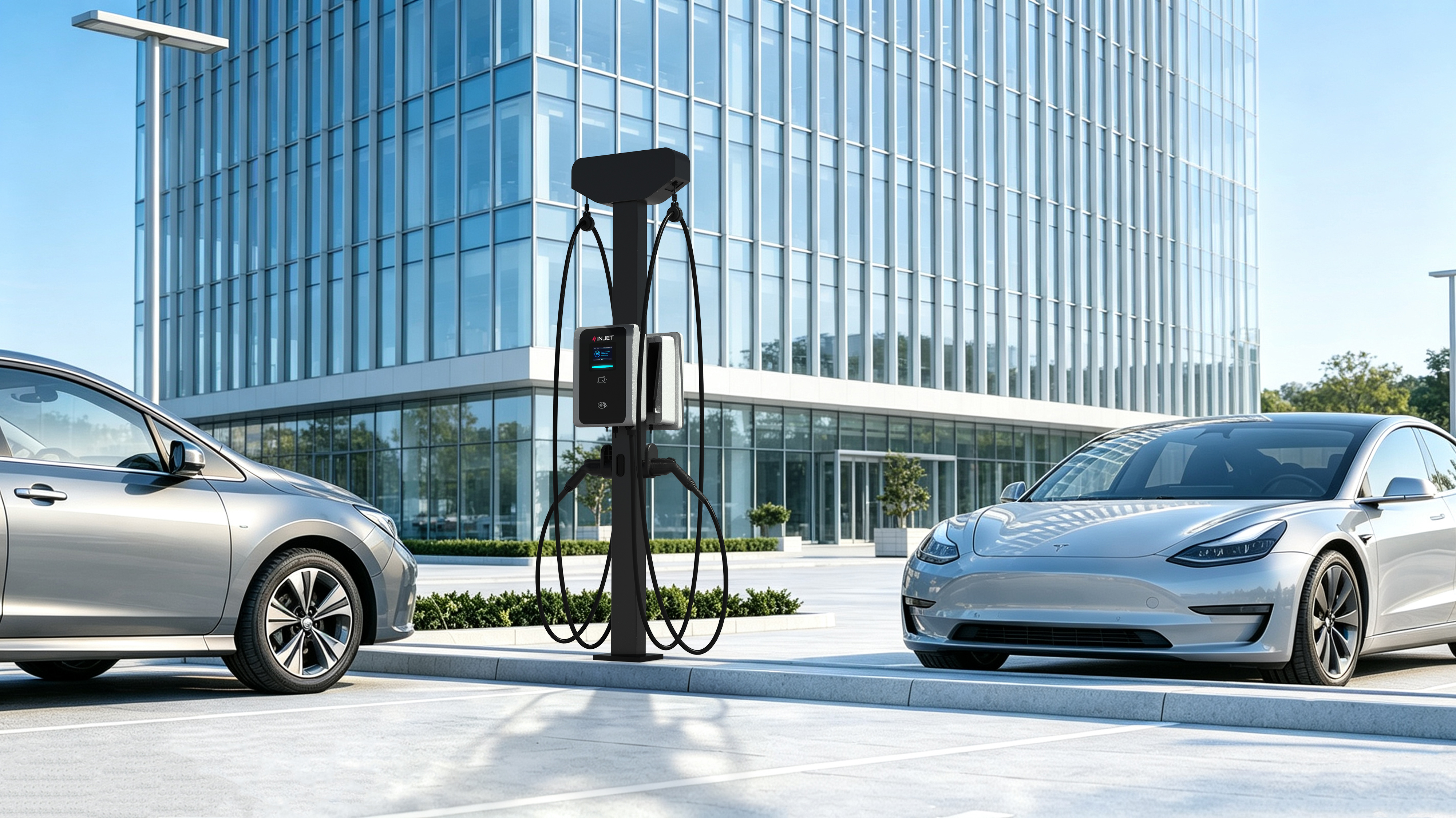
This is exactly the procurement question the Injet Vision Pro commercial Level 2 charging station was designed around. It ships with built-in PLC communication supporting ISO 15118-2 today — covering current Plug & Charge functionality — while being engineered to enable future ISO 15118-20 upgrades and bidirectional energy interaction without requiring hardware replacement down the line. That’s paired with over-the-air firmware and software updates, so security and protocol upgrades can be delivered remotely as standards evolve, rather than requiring a service visit.
For operators evaluating chargers for workplaces, multifamily properties, retail sites, and fleets, this positions the Vision Pro to stay current as ISO 15118-20, V2G, and related regulatory requirements become more mainstream — without locking a site into hardware that has to be torn out in a few years to keep pace.
FAQ: ISO 15118, Plug & Charge, and V2G
Q: What is ISO 15118 in simple terms?
A: It’s the international standard governing digital communication between an EV and a charging station — enabling automatic authentication (Plug & Charge), smart charging negotiation, and, in its newer generation, bidirectional energy flow (V2G).
Q: What’s the main difference between ISO 15118-2 and ISO 15118-20?
A: ISO 15118-2 (2014) introduced Plug & Charge for AC/DC charging over PLC. ISO 15118-20 (2022) adds mandatory TLS 1.3 encryption, native bidirectional charging (V2G/V2H/V2B), wireless communication support, and multiple simultaneous contracts — it’s a major architectural evolution, not a minor update.
Q: Does ISO 15118-20 support mean a charger already does V2G?
A: Not automatically. ISO 15118-20 support is the communication foundation V2G requires, but real-world bidirectional charging also needs compatible vehicle hardware, backend software (typically OCPP 2.1), and local grid regulations permitting energy export.
Q: Can a charger be upgraded from ISO 15118-2 to ISO 15118-20 with a software update alone?
A: It depends on the hardware. ISO 15118-20 requires more processing and memory capacity than -2, so only chargers designed with that headroom from the start — combined with OTA update capability — can typically make that transition without hardware replacement.
Q: Why does ISO 15118 matter more now than a few years ago?
A: Regulatory requirements, particularly the EU’s AFIR mandate phasing in ISO 15118-2 and -20 compliance through 2026–2027, are pushing the standard from “nice to have” toward a procurement requirement, and the direction is increasingly referenced in tenders globally.
Conclusion
ISO 15118 has quietly become one of the more consequential lines on an EV charger spec sheet — not because most sites need bidirectional charging today, but because the hardware decision made now determines whether that capability is a future software update or a future hardware replacement. Buyers evaluating chargers for the next several years are increasingly right to ask which side of that line a given product falls on.
Evaluating commercial Level 2 chargers built with ISO 15118-20 upgrade headroom in mind? Contact Injet New Energy to learn more about the Vision Pro’s communication architecture and OTA update roadmap.